
A recent decision by the Appellate Division, First Department, underscores a significant exposure point for New York condominium boards, property management companies, and their legal counsel. In Etkin v. Sherwood Residential Mgt. LLC, the court clarified how unit owners can bypass traditional standing limitations to assert derivative breach of contract actions against management entities and boards. This ruling directly impacts all condominiums in Manhattan and the Bronx and serves as highly persuasive authority for courts throughout the rest of New York State.
For years, many boards and property managers operated under the assumption that individual unit owners faced an uphill battle in suing over structural issues outside their specific interior airspaces. Etkin challenges that complacency, establishing that standard condominium governing language defining balconies as “Residential Limited Common Elements” can hand unit owners the keys to derivative standing, potentially exposing boards and management companies to costly, multi-year litigation over construction and maintenance defects.
The Dispute: Leaks, Smoke, and Standing
The plaintiff, William Etkin, purchased Unit 7A at The 500 West 21st Street Condominium in 2015. Shortly thereafter, construction defects to the penthouse balcony directly above (Penthouse A) allegedly caused ongoing water leaks and damage to Etkin’s balcony below. Etkin also alleged that unspecified construction defects allowed fireplace smoke from adjacent units to infiltrate his apartment, creating toxic conditions. He filed extensive complaints with the New York City Department of Buildings (DOB) and the Department of Housing Preservation and Development (HPD), resulting in multiple official building violations.
When the Board of Managers and its property management company failed to remediate the water and smoke issues to his satisfaction, Etkin filed suit. He asserted individual claims as well as derivative breach of contract claims on behalf of the condominium and its unit owners, alleging that the defendants breached their contractual maintenance obligations under the building’s governing documents.
The Supreme Court, New York County (Nancy M. Bannon, J.), initially granted summary judgment dismissing the plaintiff’s key claims, ruling that the unit owner lacked standing to bring a derivative breach of contract claim regarding common elements. However, on appeal, the First Department modified the order, systematically dismantling this standing defense and reviving the contractual claims.
Key Legal Takeaways from the First Department’s Ruling
1. “Limited Common Elements” Grant Derivative Standing
The core defense relied upon by the defendants was that because the balconies were designated for the exclusive use of specific unit owners, the plaintiff lacked standing to sue derivatively over their repair. The First Department rejected this argument entirely. The court noted that the building’s governing documents explicitly defined the balconies as “Residential Limited Common Elements” owned by the condominium itself, not by the individual unit owners.
Because ownership rested with the condominium association, the First Department relied on the controlling precedent in Davis v. Prestige Mgt. Inc. to hold that a unit owner appropriately brings a derivative claim on behalf of the condominium and all its unit owners for defects in such elements. This significantly widens the door for unit owners to initiate derivative litigations over balconies, terraces, patios, or yards that may carry “limited common element” status.
2. Regulatory Violations Form a Factual Basis to Defeat Summary Judgment
The court revived the unit owner’s first and third causes of action (derivative breach of contract against both the property manager and the board) by pointing to concrete evidence. The plaintiff successfully raised triable issues of fact by submitting photographs, deposition testimony, expert reports, and crucially, open violations issued by the DOB and HPD. The court noted that these regulatory notices provided sufficient baseline evidence to question whether the management company and board fulfilled their contractual maintenance and repair duties, thereby blocking the defendants’ path to an early summary dismissal.
The Danger of Open Violations: In Etkin, the plaintiff successfully moved to renew and reconsider previous dismissals by presenting brand-new DOB violations issued during the litigation. The court ruled that these new violations were highly “pertinent” to the ongoing water damage claims, legally justifying a reversal of summary judgment and completely insulating the plaintiff from the defendants’ cross-motion for frivolous litigation sanctions.
3. Evidentiary Standards: Contractual Duty vs. Speculation
Conversely, the First Department affirmed the dismissal of the plaintiff’s smoke-infiltration derivative claims. While the plaintiff proved that a smoke issue physically existed (using personal air monitoring kits), he failed to provide non-speculative evidence demonstrating that the smoke entry was caused by a specific breach of a contractual maintenance or repair obligation by the board or management. This clarifies that while standing may be easily established via governing documents, plaintiffs must still tie the defect to a specific contractual failure to survive summary judgment.
4. Duplicative Nuisance Claims Remain Subject to Dismissal
The court affirmed the dismissal of the plaintiff’s individual private nuisance claim against the Board. Because the facts undergirding the nuisance claim stemmed entirely from the Board’s alleged failure to perform “extraordinary” maintenance as dictated by the governing documents, the claim was deemed completely duplicative of the breach of contract claims. Furthermore, the court noted that individual unit owners lack standing to bring private nuisance claims for injuries caused by truly common elements, such as a shared HVAC system.
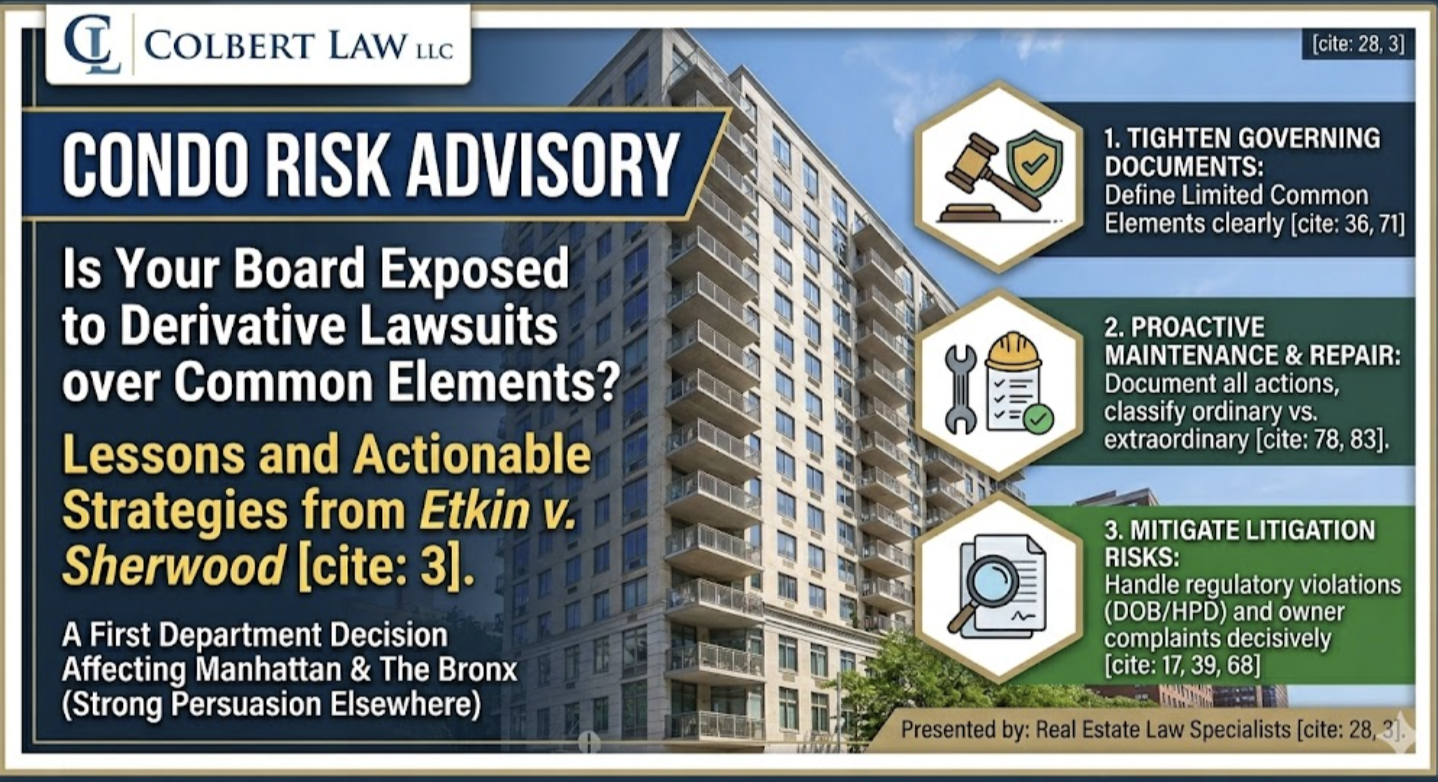
Risk Mitigation Strategies for Condominium Boards and Manage
The Etkin decision changes the risk profile for property management and community association boards across New York. To prevent unit owners from exploiting this derivative pathway, management teams and boards should consider the following:
- Audit Governing Document Definitions: Map out exactly what elements are defined as “Limited Common Elements” (balconies, structural columns, localized pipes). Clearly delineate where individual unit owner maintenance obligations end and association/board repair obligations begin and end.
- Differentiate Repair Classes: Establish operational protocols to explicitly document whether balcony or structural maintenance work is classified as “ordinary” or “extraordinary” under the building’s by-laws. The Etkin court highlighted this distinction as a critical factual issue that determines liability boundaries.
- Proactively Clear DOB/HPD Violations: Do not let municipal agency complaints linger. Because the First Department treated open DOB and HPD violations as prima facie evidence of a potential contractual breach, clearing these violations from the public record is a legal necessity to neutralize future lawsuits.
- Document Engineering & Water-Membrane Audits: Given that a core triable issue in Etkin centered on whether a waterproof membrane was intact on a penthouse balcony, boards may want to order formal architectural or engineering inspections of appurtenant exterior limited common elements and maintain comprehensive, court-ready records.
- Enforce Clear Recourse Pathways: If a unit owner complains of issues potentially stemming from equipment or alterations within another unit (such as flues, fireplaces, or localized HVAC alterations), consider invoking governing provisions that mandate owner-vs-owner responsibility, shifting the legal crosshairs away from the Board and Management.
The First Department’s decision in Etkin v. Sherwood Residential Mgt. LLC serves as a stark reminder that labels matter. Defining areas like balconies as “Limited Common Elements” grants exclusive use to residents but keeps ownership—and the corresponding structural legal liability—firmly in the hands of the condominium. Maintenance responsibility though may still be required of owners and thus, remain their responsibility depending on what your condo’s governing documents provide. When boards and management companies fail to protectively monitor these elements or allow municipal violations to accumulate, they provide disgruntled unit owners with a formidable legal mechanism to sue derivatively on behalf of the corporation.
Here is the First Department’s decision.