
• Home
  • About us
  • Capabilities
    • Condo, Coop, HOA Counsel
    • Litigation
    • Business Law
    • Technology
    • Real Estate
    • Employment Law
    • Tax Audits
    • Family Law
  • Insights
  • References
  • FAQ
  • Inquiry
    • Payment
Colbert LawColbert Law
  • Home
  • About us
  • Capabilities
    • Condo, Coop, HOA Counsel
    • Litigation
    • Business Law
    • Technology
    • Real Estate
    • Employment Law
    • Tax Audits
    • Family Law
  • Insights
  • References
  • FAQ
  • Inquiry
    • Payment

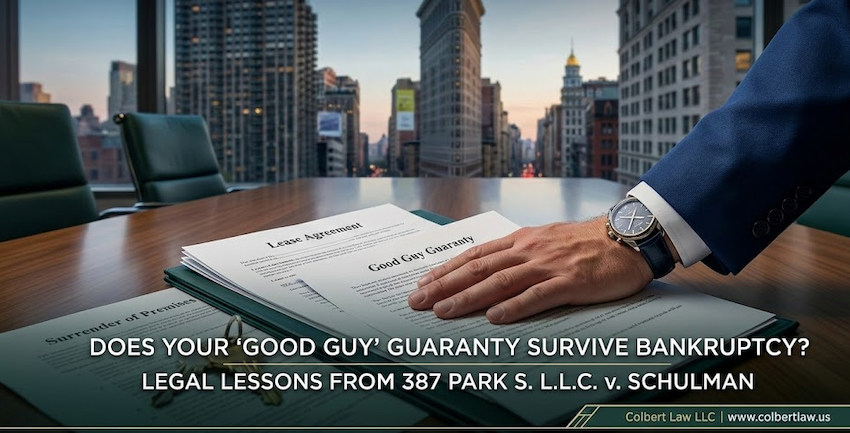
Does your current “Good Guy Guaranty” survive a tenant’s bankruptcy termination? Lessons from 387 Park S. L.L.C. v. Schulman.

Home BankruptcyDoes your current “Good Guy Guaranty” survive a tenant’s bankruptcy termination? Lessons from 387 Park S. L.L.C. v. Schulman.
Does your current “Good Guy Guaranty” survive a tenant’s bankruptcy termination? Lessons from 387 Park S. L.L.C. v. Schulman.

Does your current “Good Guy Guaranty” survive a tenant’s bankruptcy termination? Lessons from 387 Park S. L.L.C. v. Schulman.

Posted by Team Colbert Law Bankruptcy, Boards, Business, Condo Coop HOA, Litigation

In the high-stakes world of New York commercial real estate, the “Good Guy Guaranty” is often viewed as a tenant’s ultimate safety net. However, a recent decision by the New York Supreme Court, 387 Park S. L.L.C. v. Schulman (Feb 11, 2026), serves as a critical reminder that even the strongest guarantees can be limited by bankruptcy proceedings and the specific mechanics of a “vacate date.”

Landlords need to ensure their protections are ironclad and tenants need to understand the limitations of these provisions.

The Case at a Glance

The landlord (387 Park S. L.L.C.) sought over $8.8 million in unpaid rent and damages from two individual guarantors after the tenant, a restaurant group, defaulted on a lease with annual rent exceeding $2 million.

The landlord argued that because the tenant failed to provide a required 120-day notice of its intention to vacate, the guarantors should be on the hook for the remainder of the lease term. The court, however, ruled that liability was limited only to the date the premises were actually surrendered—largely because a bankruptcy judge had terminated the lease by operation of law.


Key Takeaways for Landlords and Property Managers

1. Bankruptcy Can “Clip” Your Guaranty

One of the most significant aspects of this ruling is the court’s deference to the bankruptcy stay and subsequent lease termination. Even though the “Good Guy” requirements (like the 120-day notice) weren’t met, the court held that the landlord could not recover for the entire lease term against the guarantors once the bankruptcy judge terminated the lease.

  • Management Tip: When a tenant enters bankruptcy, don’t assume your guaranty covers the full term of the lease. You must move quickly within the bankruptcy proceedings to establish the “Vacate Date” as early as possible to quantify your claim.

2. The “Defenses Waived” Clause is Your Best Friend

The landlord won on the issue of liability because the guaranty included a clause stating the defendants “waive all defenses other than payment in full.” This prevented the guarantors from blaming the landlord for construction delays or delivery issues to avoid paying.

  • Management Tip: Guaranties should be reviewed to see if they contain a broad waiver of defenses. As seen in this case, it allows the court to grant summary judgment on liability quickly, moving the fight straight to the “how much” phase rather than “if” they owe.

3. Signature Verification Still Matters

One defendant tried to claim her signature on a lease amendment was a forgery. While the court dismissed this (noting she had verified the signature in a previous lawsuit), it highlights a common delay tactic.

  • Management Tip: For high-value commercial leases, notarized signatures can turn a “forgery” defense from a potential headache into a non-starter.

4. The “Vacate Date” Ambiguity Trap

The court ordered a trial specifically to determine the exact date the tenant left (the “Vacate Date”). The parties were arguing over a window of just a few days/weeks, but at $2 million a year, every day matters.

  • Management Tip: When a tenant vacates—especially under a court order or bankruptcy—management should document the surrender immediately. Take photos, change the locks, and issue a formal “Notice of Re-entry” to cement the vacate date in the record.

How Experience Real Estate Counsel Can Protect Your Portfolio

The Schulman case proves that even with a multi-million dollar lease, a landlord’s recovery can be limited by the intersection of bankruptcy law and the specific language of a guaranty. To protect yourself, your management team must be disciplined in its documentation and aggressive in its legal positioning.

Here’s the case if your interested in an all the details ()

387 Park S. L.L.C. v Schulman __ 2026 __ New York Other Courts Decisions __ New York Case Law __ New York Law __ U.S. Law __ JustiaDownload
Share

About Team Colbert Law

With offices in New York and Connecticut, we are ready to handle your legal needs. We have been representing condo, coop and HOA boards, businesses and individual clients for over twenty five years.

You also might be interested in

Negotiating with Precision: Navigating the Legal Pitfalls of Informal Communications in Settlements

Negotiating with Precision: Navigating the Legal Pitfalls of Informal Communications in Settlements

Feb 17, 2024

When it comes to negotiating a settlement, it’s important to[...]

Coronavirus – Building Volunteers – Yes, No or Maybe?

Coronavirus – Building Volunteers – Yes, No or Maybe?

Mar 25, 2020

With coops, condos and HOAs sheltering in place because of[...]

Condo, Coop and HOA Boards have to Comply with the Corporate Transparency Act Now or Face Significant Federal Penalties

Condo, Coop and HOA Boards have to Comply with the Corporate Transparency Act Now or Face Significant Federal Penalties

Sep 13, 2024

The Corporate Transparency Act (“CTA”) is a federal law that[...]

Recent Attorney Publications

  • When Contractors Lack Licenses: Key Lessons for Condos, Co-ops, and HOAs July 25, 2026
  • When Bankruptcy Won’t Stop Your Foreclosure Sale: What Condo Boards and Management Need to Know About Repeat Filers July 22, 2026
  • When Repetitive Filings Cross the Line: Lessons from Fulton v. Yameogo July 21, 2026
  • Condominium Boards: Why Being Aware of First Mortgage “Standing” Can Protect Your Community’s Bottom Line July 13, 2026
  • Winning the Common Charge Battle: How Condo Boards Prevail Against Defiant Unit Owners July 2, 2026

Contact Us

Send us a note and we'll get back to you promptly.

OFFICES

  • Manhattan Office
  • 315 Madison Avenue, Suite 4032, New York, New York 10017
  • 646.880.3000
  • 646.880.3048
  • Westchester Office
  • 44 South Broadway, 21st Floor, White Plains, New York 10601
  • 646.880.3000
  • 646.880.3048
  • Connecticut Office
  • 55 Post Road W, 2nd Floor, Westport, Connecticut 06880
  • 203.349.8100
  • 646.880.3048

Latest Publications

  • When Contractors Lack Licenses: Key Lessons for Condos, Co-ops, and HOAs July 25, 2026
  • When Bankruptcy Won’t Stop Your Foreclosure Sale: What Condo Boards and Management Need to Know About Repeat Filers July 22, 2026
  • When Repetitive Filings Cross the Line: Lessons from Fulton v. Yameogo July 21, 2026
  • Condominium Boards: Why Being Aware of First Mortgage “Standing” Can Protect Your Community’s Bottom Line July 13, 2026

© 2026 Colbert Law LLC Attorney Advertising. Prior results do not guarantee a similar outcome.

Highend Logo

Manhattan Office

  • 315 Madison Avenue, Suite 4032, New York, New York 10017
  • 646.880.3000
  • 646.880.3048

Westchester Office

  • 44 South Broadway, 21st Floor, White Plains, New York 10601
  • 646.880.3000
  • 646.880.3048

Connecticut Office

  • 55 Post Road W, 2nd Floor, Westport, Connecticut 06880
  • 203.349.8100
  • 646.880.3048

OUR EXPERTISE

When Contractors Lack Licenses: Key Lessons for Condos, Co-ops, and HOAs

July 25, 2026

A recent NYC Civil Court decision (Fortes v. Decorating and...

When Bankruptcy Won’t Stop Your Foreclosure Sale: What Condo Boards and Management Need to Know About Repeat Filers

July 22, 2026

For condominium boards foreclosing on unpaid common charges,...

When Repetitive Filings Cross the Line: Lessons from Fulton v. Yameogo

July 21, 2026

Community association boards—whether governing condos,...

Condominium Boards: Why Being Aware of First Mortgage “Standing” Can Protect Your Community’s Bottom Line

July 13, 2026

When a condominium unit owner defaults on their monthly...

Winning the Common Charge Battle: How Condo Boards Prevail Against Defiant Unit Owners

July 2, 2026

Condominium boards and property managers face a unique,...

When the Neighbor Builds: What Condo and Co-Op Boards Need to Know

June 29, 2026

Construction in New York City is a fact of life, but when a...

Succession Rights in Limited-Equity Co-ops: Practical Lessons from Mutual Redevelopment Houses v. Manyevitch

June 12, 2026

Succession disputes are among the most sensitive and...

The Post-Settlement Trap: What Fiondella Teaches Co-op Boards About Stipulations and Continuing Habitability Claims

June 9, 2026

For New York cooperative boards and managing agents,...

The Derivative Action Threat: Why “Limited Common Elements” Present Litigation Risks for Condominium Boards and Managers

May 16, 2026

A recent decision by the Appellate Division, First...

Governance and Rule-Making in the Modern Condominium

April 27, 2026

Reflections on 10MSW17D LLC v. Bd. of Managers of 10...

Don’t Delay: Why Timely Enforcement of Common Charges is Critical for Condo Boards

April 15, 2026

A recent decision from the Supreme Court of New York,...

RPAPL § 881 Licenses, and Why Fee Reimbursement Is a Core Deal Term

April 13, 2026

Boards and managers of condominiums, cooperatives, and...

The 432 Park Decision: A Masterclass in Risk Management for New York Condo Boards

April 2, 2026

New York condominium boards and management companies operate...

Protecting Your Building’s Integrity: Lessons from Board of Mgrs. of the 80th at Madison Condominium v. 1055 Madison Ave. Owners LLC

March 31, 2026

As a condominium board member or property manager, your...

Press Enter to search · Esc to close