
• Home
  • About us
  • Capabilities
    • Condo, Coop, HOA Counsel
    • Litigation
    • Business Law
    • Technology
    • Real Estate
    • Employment Law
    • Tax Audits
    • Family Law
  • Insights
  • References
  • FAQ
  • Inquiry
    • Payment
Colbert LawColbert Law
  • Home
  • About us
  • Capabilities
    • Condo, Coop, HOA Counsel
    • Litigation
    • Business Law
    • Technology
    • Real Estate
    • Employment Law
    • Tax Audits
    • Family Law
  • Insights
  • References
  • FAQ
  • Inquiry
    • Payment

The 432 Park Decision: A Masterclass in Risk Management for New York Condo Boards

Home UncategorizedThe 432 Park Decision: A Masterclass in Risk Management for New York Condo Boards
The 432 Park Decision: A Masterclass in Risk Management for New York Condo Boards

The 432 Park Decision: A Masterclass in Risk Management for New York Condo Boards

Posted by Team Colbert Law Uncategorized

New York condominium boards and management companies operate in a high-stakes environment where capital projects, resident expectations, and vendor disputes often collide. When these tensions escalate into complex litigation, the difference between a swift resolution and a multi-year drain on building finances often comes down to one thing: operational discipline.

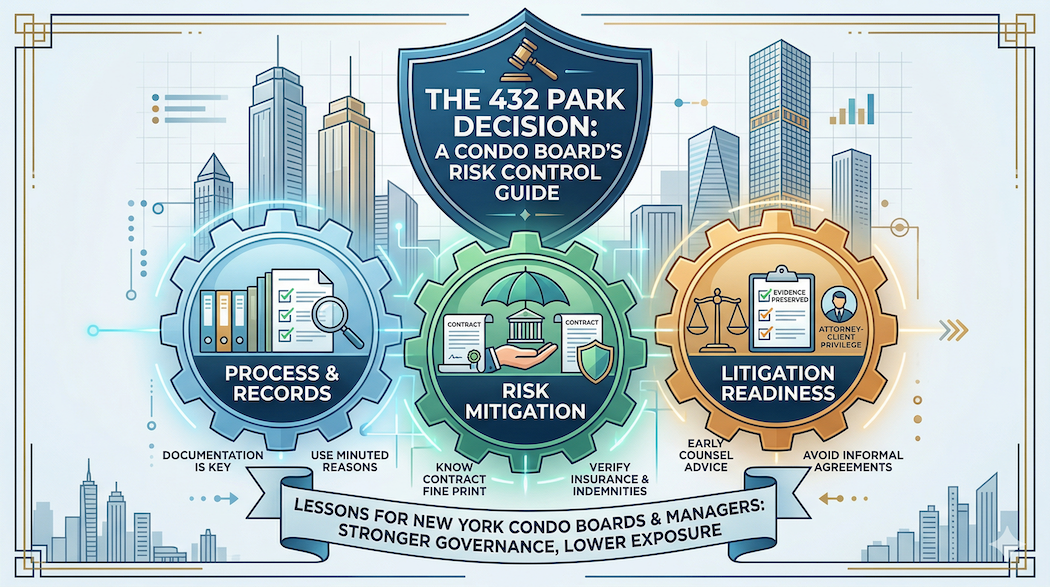
The recent litigation involving the Board of Managers of the 432 Park Condominium serves as a vital reminder that governance, documentation, and early legal strategy are not administrative afterthoughts—they are core defensive functions.

Below are the key takeaways from the court’s findings for boards and managing agents.


1. Process Over Outcome: The Shield of the Business Judgment Rule

A recurring theme in New York board litigation is that courts focus less on the popularity of a decision and more on the process used to reach it. A well-documented path—supported by expert consultants, detailed meeting minutes, and a clear rationale—is often the key to securing an early dismissal.

2. Pleading Standards: The Importance of “Who, What, When, and Where”

The 432 Park decision underscores that claims and defenses often fail when they rely on general conclusions rather than specific, provable facts. In the eyes of the court, a “general grievance” is rarely a “legal cause of action.”

3. The Lethal Power of the Fine Print

Many condo disputes are won or lost in the boilerplate: notice requirements, limitation-of-liability clauses, and insurance procurement deadlines. The court’s analysis in 432 Park highlights how missing a contractual deadline or failing to trigger an indemnification clause can fundamentally weaken a board’s position.

4. Litigation Readiness Starts Before the Index Number

When building issues like water intrusion or façade defects occur, the instinct may be to “fix first and sort it out later.” While safety is the priority, “fixing” can inadvertently destroy evidence needed for recovery.

5. Digital Footprints: Communication as Evidence

In the discovery phase of litigation, every email, newsletter, and internal memo becomes a potential exhibit. The 432 Park litigation reminds us that internal speculation—especially regarding fault or causation—can be used against the board. When the board or management includes counsel early on in communications, the attorney-client privilege can protect the communications from disclosure to adversaries.


The Bottom Line: Governance is Risk Control

The 432 Park Condominium decision reinforces a core principle: strong governance and meticulous records are the ultimate legal risk controls. Boards that invest in a rigorous process today are far better positioned to protect their residents’ assets and achieve favorable outcomes when disputes inevitably arise. Getting counsel involved early on can save the condo when the dispute escalates into a litigation.

Here is the court’s decision.

Board of Mgrs. of the 432 Park _dominium_2026 N.Y. App. Div. LEXIS 699Download
Share

About Team Colbert Law

With offices in New York and Connecticut, we are ready to handle your legal needs. We have been representing condo, coop and HOA boards, businesses and individual clients for over twenty five years.

You also might be interested in

New Electronic Discovery Rules in New York State Court

New Electronic Discovery Rules in New York State Court

May 11, 2022

The New York State Unified Court System just adopted additional[...]

Condo & Coop Licenses in NYC: Granting Access to Adjoining Buildings for Necessary Work

Condo & Coop Licenses in NYC: Granting Access to Adjoining Buildings for Necessary Work

Feb 11, 2025

As a board member or property manager of a condominium[...]

Professional, Civil and Criminal Risks when Attorneys Serve as Board Members

Professional, Civil and Criminal Risks when Attorneys Serve as Board Members

Sep 18, 2022

Many Coops, Condos and HOAs have board members who are[...]

Recent Attorney Publications

  • When Contractors Lack Licenses: Key Lessons for Condos, Co-ops, and HOAs July 25, 2026
  • When Bankruptcy Won’t Stop Your Foreclosure Sale: What Condo Boards and Management Need to Know About Repeat Filers July 22, 2026
  • When Repetitive Filings Cross the Line: Lessons from Fulton v. Yameogo July 21, 2026
  • Condominium Boards: Why Being Aware of First Mortgage “Standing” Can Protect Your Community’s Bottom Line July 13, 2026
  • Winning the Common Charge Battle: How Condo Boards Prevail Against Defiant Unit Owners July 2, 2026

Contact Us

Send us a note and we'll get back to you promptly.

OFFICES

  • Manhattan Office
  • 315 Madison Avenue, Suite 4032, New York, New York 10017
  • 646.880.3000
  • 646.880.3048
  • Westchester Office
  • 44 South Broadway, 21st Floor, White Plains, New York 10601
  • 646.880.3000
  • 646.880.3048
  • Connecticut Office
  • 55 Post Road W, 2nd Floor, Westport, Connecticut 06880
  • 203.349.8100
  • 646.880.3048

Latest Publications

  • When Contractors Lack Licenses: Key Lessons for Condos, Co-ops, and HOAs July 25, 2026
  • When Bankruptcy Won’t Stop Your Foreclosure Sale: What Condo Boards and Management Need to Know About Repeat Filers July 22, 2026
  • When Repetitive Filings Cross the Line: Lessons from Fulton v. Yameogo July 21, 2026
  • Condominium Boards: Why Being Aware of First Mortgage “Standing” Can Protect Your Community’s Bottom Line July 13, 2026

© 2026 Colbert Law LLC Attorney Advertising. Prior results do not guarantee a similar outcome.

Highend Logo

Manhattan Office

  • 315 Madison Avenue, Suite 4032, New York, New York 10017
  • 646.880.3000
  • 646.880.3048

Westchester Office

  • 44 South Broadway, 21st Floor, White Plains, New York 10601
  • 646.880.3000
  • 646.880.3048

Connecticut Office

  • 55 Post Road W, 2nd Floor, Westport, Connecticut 06880
  • 203.349.8100
  • 646.880.3048

OUR EXPERTISE

When Contractors Lack Licenses: Key Lessons for Condos, Co-ops, and HOAs

July 25, 2026

A recent NYC Civil Court decision (Fortes v. Decorating and...

When Bankruptcy Won’t Stop Your Foreclosure Sale: What Condo Boards and Management Need to Know About Repeat Filers

July 22, 2026

For condominium boards foreclosing on unpaid common charges,...

When Repetitive Filings Cross the Line: Lessons from Fulton v. Yameogo

July 21, 2026

Community association boards—whether governing condos,...

Condominium Boards: Why Being Aware of First Mortgage “Standing” Can Protect Your Community’s Bottom Line

July 13, 2026

When a condominium unit owner defaults on their monthly...

Winning the Common Charge Battle: How Condo Boards Prevail Against Defiant Unit Owners

July 2, 2026

Condominium boards and property managers face a unique,...

When the Neighbor Builds: What Condo and Co-Op Boards Need to Know

June 29, 2026

Construction in New York City is a fact of life, but when a...

Succession Rights in Limited-Equity Co-ops: Practical Lessons from Mutual Redevelopment Houses v. Manyevitch

June 12, 2026

Succession disputes are among the most sensitive and...

The Post-Settlement Trap: What Fiondella Teaches Co-op Boards About Stipulations and Continuing Habitability Claims

June 9, 2026

For New York cooperative boards and managing agents,...

The Derivative Action Threat: Why “Limited Common Elements” Present Litigation Risks for Condominium Boards and Managers

May 16, 2026

A recent decision by the Appellate Division, First...

Governance and Rule-Making in the Modern Condominium

April 27, 2026

Reflections on 10MSW17D LLC v. Bd. of Managers of 10...

Don’t Delay: Why Timely Enforcement of Common Charges is Critical for Condo Boards

April 15, 2026

A recent decision from the Supreme Court of New York,...

RPAPL § 881 Licenses, and Why Fee Reimbursement Is a Core Deal Term

April 13, 2026

Boards and managers of condominiums, cooperatives, and...

The 432 Park Decision: A Masterclass in Risk Management for New York Condo Boards

April 2, 2026

New York condominium boards and management companies operate...

Protecting Your Building’s Integrity: Lessons from Board of Mgrs. of the 80th at Madison Condominium v. 1055 Madison Ave. Owners LLC

March 31, 2026

As a condominium board member or property manager, your...

Press Enter to search · Esc to close