
• Home
  • About us
  • Capabilities
    • Condo, Coop, HOA Counsel
    • Litigation
    • Business Law
    • Technology
    • Real Estate
    • Employment Law
    • Tax Audits
    • Family Law
  • Insights
  • References
  • FAQ
  • Inquiry
    • Payment
Colbert LawColbert Law
  • Home
  • About us
  • Capabilities
    • Condo, Coop, HOA Counsel
    • Litigation
    • Business Law
    • Technology
    • Real Estate
    • Employment Law
    • Tax Audits
    • Family Law
  • Insights
  • References
  • FAQ
  • Inquiry
    • Payment

When Repetitive Filings Cross the Line: Lessons from Fulton v. Yameogo

Home BoardsWhen Repetitive Filings Cross the Line: Lessons from Fulton v. Yameogo
When Repetitive Filings Cross the Line: Lessons from Fulton v. Yameogo

When Repetitive Filings Cross the Line: Lessons from Fulton v. Yameogo

Posted by Joseph Colbert, Esq. Boards, Business, Condo Coop HOA, Litigation, Real Estate

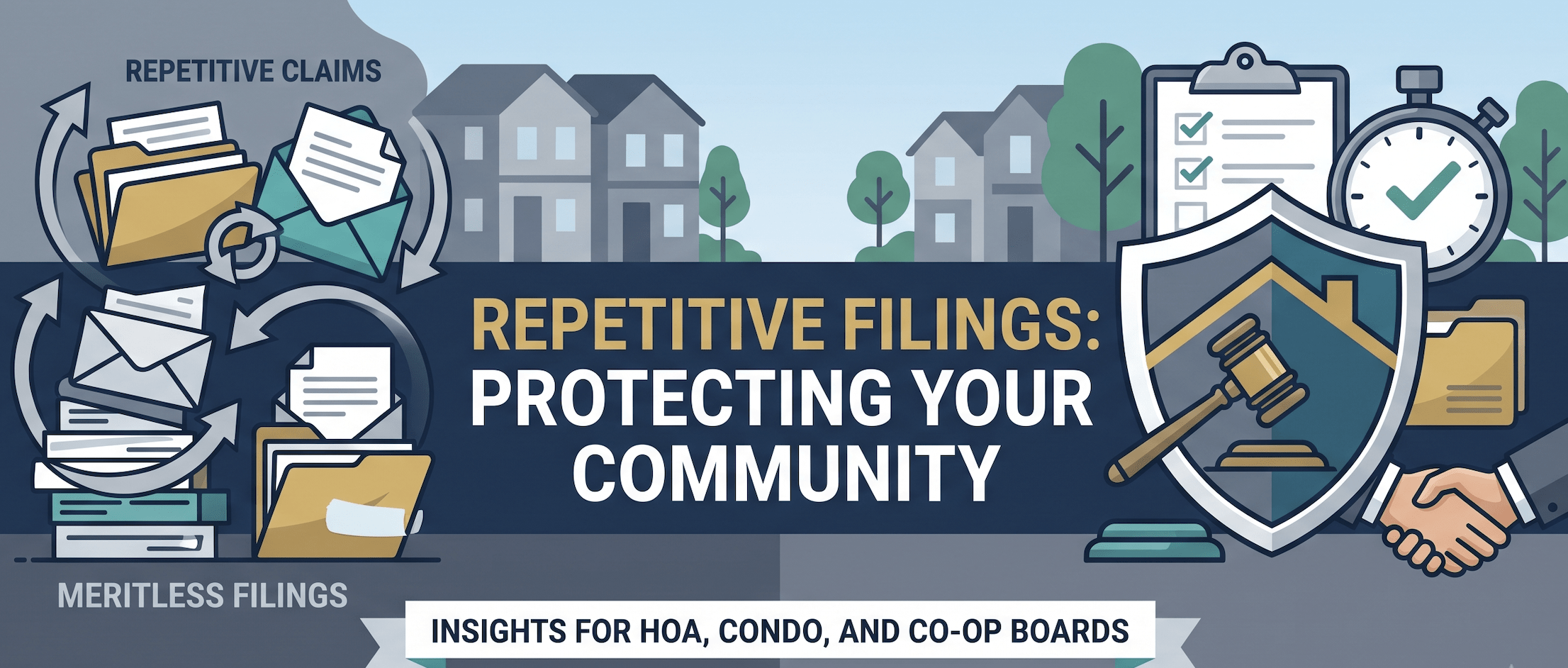
Community association boards—whether governing condos, HOAs, or co-ops—frequently deal with difficult residents. While owners have a right to challenge board decisions, that right isn’t unlimited.

A New York decision, 2104 Fulton, LLC v. Yameogo, highlights how courts respond when an individual moves past vigorous advocacy into abusive, repetitive litigation designed purely to obstruct. Here is what happened, and how association boards can use these principles to handle bad-faith litigants.

What Happened in Fulton v. Yameogo?

Though Fulton began as a commercial lease dispute, its lessons apply to any board dealing with serial filers:

  1. The Pattern: A tenant facing eviction filed six separate orders to show cause across two courts to delay the process.
  2. The Recycled Arguments: In every filing, he repeated the exact same claims (alleging forged lease documents and health code violations) that the court had already rejected.
  3. The Warning Ignored: The court explicitly warned the tenant that his claims were barred, sanctioned him $100, and cited his abuse of the process. He ignored the warning and filed another motion after the eviction was already completed.

The court ruled his conduct frivolous, found he engaged in a deliberate strategy to delay, and hit him with legal sanctions.

The Legal Framework: When Does Advocacy Become Abuse?

Courts recognize a constitutional right to petition for relief, but they also hold inherent authority to stop litigants who act in bad faith.

  • Single Lawsuits vs. Patterns: To prove a single lawsuit is a “sham,” it must be completely baseless. However, when evaluating a series of filings, courts look at the holistic pattern. A stream of repetitive, unsuccessful filings evidences an intent to abuse the judicial system rather than seek genuine justice.
  • Collateral Estoppel (Issue Preclusion):  Repeating claims that have already been thrown out by a Court, transitions a case from aggressive defense to illegal harassment.

4 Red Flags of Abusive Resident Conduct

Boards dealing with difficult owners should watch for these signs of bad-faith litigation:

  • Repetition: Raising the exact same grievance after it has been formally decided or dismissed.
  • Lack of Legal Merit: Filings that ignore governing documents, statutes, or established facts.
  • Motive to Obstruct: Using procedural delays to drain association resources, harass management, or delay valid board actions.
  • Ignoring Rulings: Continuing to file claims despite prior adverse decisions or official warnings.

Practical Steps for Boards

If a resident enters a cycle of repetitive, meritless claims, boards should take these five proactive steps:

  1. Document Everything: Keep a detailed, chronological record of every filing, appeal, written ruling, and warning showing the pattern.
  2. Leverage Governing Documents: Review your bylaws with legal counsel. Look for clauses that limit appeal attempts, allow attorney fee recovery for frivolous actions, or impose fines for disruptive conduct.
  3. Seek Sanctions: When litigation is involved, ask the court for monetary penalties, attorney’s fees reimbursement, or an injunction barring the owner from making further filings without prior court approval.

Proceed with Caution

Sanctions are reserved for severe cases. A single aggressive filing or an unsuccessful good-faith argument does not qualify as abuse. Boards must never use threats of sanctions to suppress legitimate dissent. Work closely with association counsel to ensure you are protecting community resources without infringing on owner rights.

Read the case here:

2104 Fulton_ LLC v Yameogo_2026 N.Y. Misc. LEXIS 9470Download
Share

About Joseph Colbert, Esq.

With offices in New York and Connecticut, we are ready to handle your legal needs. We have been representing condo, coop and HOA boards, businesses and individual clients for over twenty five years.

You also might be interested in

Condominium Construction Defect Lawsuits: When Sponsors Bring Architects into the Fray

Condominium Construction Defect Lawsuits: When Sponsors Bring Architects into the Fray

Apr 20, 2024

Condominium boards embroiled in construction defect lawsuits against developers (sponsors)[...]

New York Condo Boards and Management Beware: Eshaghour Case in Manhattan Sets Precedent for Individual Liability

New York Condo Boards and Management Beware: Eshaghour Case in Manhattan Sets Precedent for Individual Liability

Aug 27, 2024

A New York Supreme Court decision by Justice Lebovits in[...]

Pets that Bite – COVID-19 made it even more complicated for coop, condo and HOA boards.

Pets that Bite – COVID-19 made it even more complicated for coop, condo and HOA boards.

Mar 30, 2020

Pets are fantastic but when they demonstrate the propensity to[...]

Recent Attorney Publications

  • When Contractors Lack Licenses: Key Lessons for Condos, Co-ops, and HOAs July 25, 2026
  • When Bankruptcy Won’t Stop Your Foreclosure Sale: What Condo Boards and Management Need to Know About Repeat Filers July 22, 2026
  • When Repetitive Filings Cross the Line: Lessons from Fulton v. Yameogo July 21, 2026
  • Condominium Boards: Why Being Aware of First Mortgage “Standing” Can Protect Your Community’s Bottom Line July 13, 2026
  • Winning the Common Charge Battle: How Condo Boards Prevail Against Defiant Unit Owners July 2, 2026

Contact Us

Send us a note and we'll get back to you promptly.

OFFICES

  • Manhattan Office
  • 315 Madison Avenue, Suite 4032, New York, New York 10017
  • 646.880.3000
  • 646.880.3048
  • Westchester Office
  • 44 South Broadway, 21st Floor, White Plains, New York 10601
  • 646.880.3000
  • 646.880.3048
  • Connecticut Office
  • 55 Post Road W, 2nd Floor, Westport, Connecticut 06880
  • 203.349.8100
  • 646.880.3048

Latest Publications

  • When Contractors Lack Licenses: Key Lessons for Condos, Co-ops, and HOAs July 25, 2026
  • When Bankruptcy Won’t Stop Your Foreclosure Sale: What Condo Boards and Management Need to Know About Repeat Filers July 22, 2026
  • When Repetitive Filings Cross the Line: Lessons from Fulton v. Yameogo July 21, 2026
  • Condominium Boards: Why Being Aware of First Mortgage “Standing” Can Protect Your Community’s Bottom Line July 13, 2026

© 2026 Colbert Law LLC Attorney Advertising. Prior results do not guarantee a similar outcome.

Highend Logo

Manhattan Office

  • 315 Madison Avenue, Suite 4032, New York, New York 10017
  • 646.880.3000
  • 646.880.3048

Westchester Office

  • 44 South Broadway, 21st Floor, White Plains, New York 10601
  • 646.880.3000
  • 646.880.3048

Connecticut Office

  • 55 Post Road W, 2nd Floor, Westport, Connecticut 06880
  • 203.349.8100
  • 646.880.3048

OUR EXPERTISE

When Contractors Lack Licenses: Key Lessons for Condos, Co-ops, and HOAs

July 25, 2026

A recent NYC Civil Court decision (Fortes v. Decorating and...

When Bankruptcy Won’t Stop Your Foreclosure Sale: What Condo Boards and Management Need to Know About Repeat Filers

July 22, 2026

For condominium boards foreclosing on unpaid common charges,...

When Repetitive Filings Cross the Line: Lessons from Fulton v. Yameogo

July 21, 2026

Community association boards—whether governing condos,...

Condominium Boards: Why Being Aware of First Mortgage “Standing” Can Protect Your Community’s Bottom Line

July 13, 2026

When a condominium unit owner defaults on their monthly...

Winning the Common Charge Battle: How Condo Boards Prevail Against Defiant Unit Owners

July 2, 2026

Condominium boards and property managers face a unique,...

When the Neighbor Builds: What Condo and Co-Op Boards Need to Know

June 29, 2026

Construction in New York City is a fact of life, but when a...

Succession Rights in Limited-Equity Co-ops: Practical Lessons from Mutual Redevelopment Houses v. Manyevitch

June 12, 2026

Succession disputes are among the most sensitive and...

The Post-Settlement Trap: What Fiondella Teaches Co-op Boards About Stipulations and Continuing Habitability Claims

June 9, 2026

For New York cooperative boards and managing agents,...

The Derivative Action Threat: Why “Limited Common Elements” Present Litigation Risks for Condominium Boards and Managers

May 16, 2026

A recent decision by the Appellate Division, First...

Governance and Rule-Making in the Modern Condominium

April 27, 2026

Reflections on 10MSW17D LLC v. Bd. of Managers of 10...

Don’t Delay: Why Timely Enforcement of Common Charges is Critical for Condo Boards

April 15, 2026

A recent decision from the Supreme Court of New York,...

RPAPL § 881 Licenses, and Why Fee Reimbursement Is a Core Deal Term

April 13, 2026

Boards and managers of condominiums, cooperatives, and...

The 432 Park Decision: A Masterclass in Risk Management for New York Condo Boards

April 2, 2026

New York condominium boards and management companies operate...

Protecting Your Building’s Integrity: Lessons from Board of Mgrs. of the 80th at Madison Condominium v. 1055 Madison Ave. Owners LLC

March 31, 2026

As a condominium board member or property manager, your...

Press Enter to search · Esc to close