

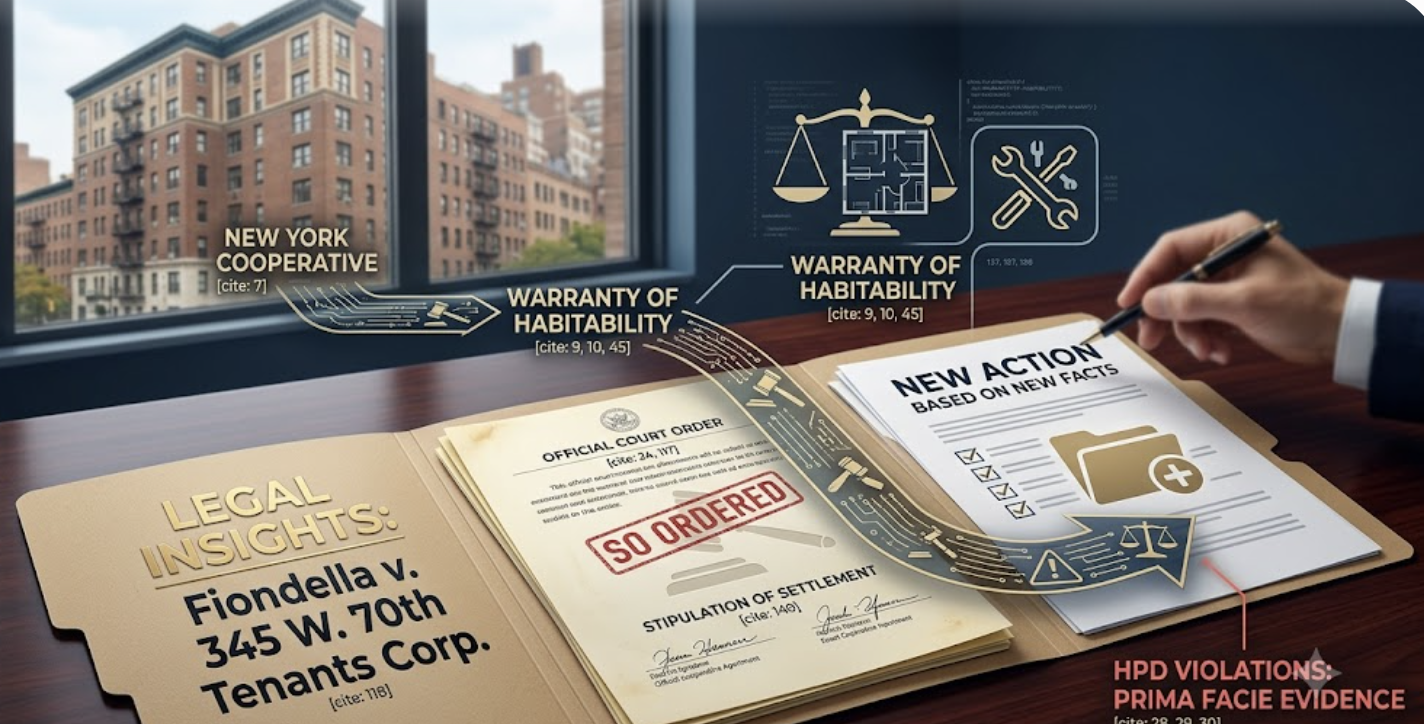
For New York cooperative boards and managing agents, executing a “so-ordered” stipulation of settlement in open court feels like crossing the finish line of a grueling litigation marathon. The common assumption is that once a judge signs off on a settlement resolving a shareholder’s complaints about repairs or building conditions, the dispute is permanently laid to rest.
However, a recent decision by the Appellate Division, First Department, underscores that a stipulation is not always the end of the story. In Fiondella v. 345 W. 70th Tenants Corp. (2026 NY Slip Op 01595, 247 A.D.3d 565), the court provided a masterclass on the procedural boundaries of post-settlement disputes, the strict standards of unconscionability, and how a co-op can accidentally leave the door open for follow-on litigation.
Here is a summary of the Fiondella case and the critical, practical insights it offers for New York co-op boards and their management teams.
The Case: Fiondella v. 345 West 70th Tenants Corp.
The Background and Settlement
The plaintiff, Paul Fiondella, brought an action against his co-op board in 2019 regarding structural defects and repair failures in his apartment. In January 2020, the parties entered into a so-ordered stipulation of settlement. The deal was straightforward on its face: the cooperative agreed to perform specific structural repairs, and Fiondella agreed to provide a formal release of claims upon completion. Fiondella was represented by legal counsel throughout these negotiations.
The Fallout and New Claims
Predictably, the peace did not last. Fiondella later moved to restore the original 2019 action and vacate the January 2020 stipulation. He claimed that the co-op breached the agreement by failing to resolve outstanding housing violations by late 2021. Furthermore, he claimed that the co-op’s ongoing failure to execute proper repairs forced him to sell his apartment in April 2022 at a loss. Fiondella tried to argue that the stipulation itself was procedurally and substantively unconscionable, alleging he was coerced into it because the board had threatened to terminate his proprietary lease.
The Supreme Court denied his motion to vacate the stipulation, and the First Department unanimously affirmed.
Key Legal Takeaways from the First Department
1. Post-Stipulation Claims Belong in a New Action
The core procedural ruling in Fiondella centers on General Obligations Law § 15-501(3). While a party can sometimes restore an action if an executory accord (like a settlement stipulation) is breached, the First Department clarified that because Fiondella’s new claims rested on “new facts that were not previously pleaded” in the 2019 lawsuit—specifically, damages for an apartment sale that happened years later and post-stipulation habitability issues—vacatur was improper.
Instead, the court noted that Fiondella was properly granted leave to bring his unresolved, post-stipulation claims in a completely new lawsuit.
2. High Bar for Unconscionability in So-Ordered Stipulations
Fiondella’s attempt to blow up the settlement by claiming “coercion” and “one-sidedness” failed miserably. The court reinforced that under New York law, a stipulation will not be disturbed absent fraud, collusion, mistake, or duress.
The court soundly rejected the unconscionability argument for two reasons:
- Procedural: Fiondella was represented by counsel at all times, and the agreement was vetted and so-ordered by a judge.
- Substantive: The terms actually favored Fiondella because they legally compelled the co-op to perform major structural repairs it had previously refused to do. A threat to terminate a lease through proper legal channels does not equal lack of meaningful choice.
3. Open Violations Keep the Door Open to Trial
The co-op didn’t escape completely unscathed. The board had brought a counterclaim against Fiondella for breaching the stipulation because he refused to give them the agreed-upon release. Fiondella tried to dismiss this counterclaim, pointing out that documentary evidence proved the co-op still had open building violations of record as of December 2021.
The co-op argued that Fiondella’s ultimate purchaser had waived or accepted those conditions. The First Department ruled that this factual dispute—whether the violations were actually cured or legally waived—must be decided on the merits at trial. Because the violations remained open on paper, the co-op could not summarily prove it was entitled to the release.
Practical Insights for Co-op Boards and Managing Agents
The Fiondella decision serves as a guide for how co-op boards might approach litigation exits and ongoing building maintenance.
Treat Stipulations as Risk-Management Tools, Not Just Ways Out of Court
A stipulation is a binding contract. Because Fiondella highlights that a shareholder can simply file a new lawsuit based on post-stipulation conduct, boards must draft agreements with an eye toward preventing future litigation.
- Define Scope and Benchmarks: When agreeing to repairs, do not just write “Board will fix the structural issues.” Defining the precise scope, access protocols, third-party vendor timelines, and objective completion benchmarks would be helpful. This may reduce the chance a shareholder can allege “new facts” regarding a failure to perform.
The Trap of Open HPD/Building Violations
In New York, Department of Housing Preservation and Development (HPD) or other building violations are treated as prima facie evidence of hazardous conditions that threaten life, health, or safety.
- As seen in this litigation web, as long as violations remain open of record, they serve as powerful evidentiary anchors for a shareholder.
- Co-op managers should track remediation steps and actively secure formal dismissals or re-inspection completions from the city. Merely completing the physical repair is not enough; clearing the administrative record to secure your legal release is a good idea.
The Inherent Bounds of the Business Judgment Rule
Co-op boards generally enjoy immense protection under the Business Judgment Rule for maintenance prioritization and corporate decision-making. However, this deference has a hard ceiling when it collides with Real Property Law § 235-b (the Implied Warranty of Habitability).
- A shareholder’s obligation to pay maintenance is legally tied to the co-op’s duty to maintain habitable conditions, and statutory habitability rights cannot be waived or contracted away in a settlement.
- Boards should document their good-faith efforts (vendor logs, access requests sent to shareholders, engineering reports). This paper trail ensures that if a follow-on lawsuit is filed, the board can decisively trigger Business Judgment protection.
Fiondella v. 345 W. 70th Tenants Corp. reminds us that defeating a motion to vacate a settlement is a hollow victory if the board’s post-settlement performance invites a brand-new lawsuit. To achieve true finality, co-op boards and managing agents should ensure that stipulations are meticulously drafted, repair obligations are executed, and building violations are cleared from city records.
Here is the Court’s decision.