
• Home
  • About us
  • Capabilities
    • Condo, Coop, HOA Counsel
    • Litigation
    • Business Law
    • Technology
    • Real Estate
    • Employment Law
    • Tax Audits
    • Family Law
  • Insights
  • References
  • FAQ
  • Inquiry
    • Payment
Colbert LawColbert Law
  • Home
  • About us
  • Capabilities
    • Condo, Coop, HOA Counsel
    • Litigation
    • Business Law
    • Technology
    • Real Estate
    • Employment Law
    • Tax Audits
    • Family Law
  • Insights
  • References
  • FAQ
  • Inquiry
    • Payment

New Requirements for NY Coops & Incorporated Condos regarding Board Member Conflicts of Interest

Home BoardsNew Requirements for NY Coops & Incorporated Condos regarding Board Member Conflicts of Interest
New Requirements for NY Coops & Incorporated Condos regarding Board Member Conflicts of Interest

New Requirements for NY Coops & Incorporated Condos regarding Board Member Conflicts of Interest

Posted by Team Colbert Law Boards, Condo Coop HOA, Real Estate

A new law (effective January 1, 2018) was just passed unanimously by Senators throughout New York which will make it more difficult for cooperative and condominium managers and boards to deal with board member conflicts of interest when it comes to contracts.  Conflicts of interest in contract making can no longer be overlooked and must be reported to condo owners and coop shareholders.  The New York Legislature is clearly pushing coops and condos to be transparent with owners and shareholders.

The first new requirement is that condos and coops must give each board member a copy of the applicable law at least once annually.  For an incorporated condominium, Section 715 of the Not-for-Profit Corporation’s law and for incorporated coops, Section 713 of the Business Corporation Law.  Those sections could be confusing without explaining to board members what an ‘interest in a related party transaction” is when it comes to condo board members’ interests and what a “substantial financial interest” of a coop board member is.  If those standards are implicated, a disclosure must be made.  Boards and management need a way to track when board members are given copies of these laws as it will be essential to prove such sometime in the future. Compliant record keeping is essential.

Imagine a board deciding to enter into a vendor contract and the board president’s brother-in-law is the vendor. This interested transaction must be reported as it presents a potential conflict of interest.  Fast forward two years from then and the board and board member are sued relating to the contract and the conflict of interest that was not reported.  The board showing that the proper documentation was provided to each board members at least annually in accordance with the new law and that the board and board members other than the president had no idea of the president’s conflict would be essential in establishing a defense in a lawsuit.  Otherwise, the board is exposed to potential liability for not complying with the law.

In addition to providing the right documentation to board members at least annually, board members have to provide an Annual Report to the coop shareholders or condo owners representing that either there were no actions taken by the board that fall within Section 519-A of the Not-for-Profit Corporation Law for the incorporated condominiums or within Section 727 of the Business Corporation Law for incorporated cooperatives.  The Annual Report must be signed by each of the board members.  If there were such actions by the board during the year, then the board must provide information on any contracts made, entered into, or otherwise voted on by the board that were considered related party transactions in the case of incorporated condominiums, or where one or more of the board members were interested.

Further, the Annual Report has to include a list of all contracts voted on by the board including information on the contract recipient, contract amount and the purpose of entering into the contract, the record of each meeting including board member attendance, voting records for the contract and how each board member voted on such contracts, and the date of each vote on each contact and the date the contract would be and remain valid.  The law is a bit ambiguous as to whether the board has to report this information on each and every contract, or just the ones that involve board member conflicts of interest.

In view of these new requirements, it is essential for board and their management to keep track of all of this information in a proactive way.  Many boards have failed to keep track of votes and which board member voted for or against a contract.   Boards often recorded a passed or not passed record in their minutes, and no record of how each board member voted.  Based on this new law, in order to prepare the Annual Report, minutes on votes on contracts have to identify which board members were in attendance for a vote and how each board member voted.

Unfortunately the lawmakers didn’t provide the consequences of noncompliance.  We will have to wait for the inevitable lawsuits to start and Court will have to decide the appropriate consequences of noncompliance.  As explained above, in a lawsuit where a board and its members cannot point to good record keeping and Annual Reporting in compliance with the new law, they will likely find themselves on the wrong side of liability and perhaps unable to establish the applicability of defenses like the often cited Business Judgment Rule.  It is critical for boards and management to be proactive in complying with this new law.

Click here to read this significant law change.

Share

About Team Colbert Law

With offices in New York and Connecticut, we are ready to handle your legal needs. We have been representing condo, coop and HOA boards, businesses and individual clients for over twenty five years.

You also might be interested in

Condo & Coop Licenses in NYC: Granting Access to Adjoining Buildings for Necessary Work

Condo & Coop Licenses in NYC: Granting Access to Adjoining Buildings for Necessary Work

Feb 11, 2025

As a board member or property manager of a condominium[...]

Wage Transparency Requirements

Wage Transparency Requirements

Sep 21, 2022

The way co-op and condo boards advertise job openings, recruit[...]

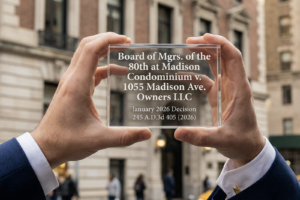
Protecting Your Building’s Integrity: Lessons from Board of Mgrs. of the 80th at Madison Condominium v. 1055 Madison Ave. Owners LLC

Protecting Your Building’s Integrity: Lessons from Board of Mgrs. of the 80th at Madison Condominium v. 1055 Madison Ave. Owners LLC

Mar 31, 2026

As a condominium board member or property manager, your primary[...]

Recent Attorney Publications

  • When Contractors Lack Licenses: Key Lessons for Condos, Co-ops, and HOAs July 25, 2026
  • When Bankruptcy Won’t Stop Your Foreclosure Sale: What Condo Boards and Management Need to Know About Repeat Filers July 22, 2026
  • When Repetitive Filings Cross the Line: Lessons from Fulton v. Yameogo July 21, 2026
  • Condominium Boards: Why Being Aware of First Mortgage “Standing” Can Protect Your Community’s Bottom Line July 13, 2026
  • Winning the Common Charge Battle: How Condo Boards Prevail Against Defiant Unit Owners July 2, 2026

Contact Us

Send us a note and we'll get back to you promptly.

OFFICES

  • Manhattan Office
  • 315 Madison Avenue, Suite 4032, New York, New York 10017
  • 646.880.3000
  • 646.880.3048
  • Westchester Office
  • 44 South Broadway, 21st Floor, White Plains, New York 10601
  • 646.880.3000
  • 646.880.3048
  • Connecticut Office
  • 55 Post Road W, 2nd Floor, Westport, Connecticut 06880
  • 203.349.8100
  • 646.880.3048

Latest Publications

  • When Contractors Lack Licenses: Key Lessons for Condos, Co-ops, and HOAs July 25, 2026
  • When Bankruptcy Won’t Stop Your Foreclosure Sale: What Condo Boards and Management Need to Know About Repeat Filers July 22, 2026
  • When Repetitive Filings Cross the Line: Lessons from Fulton v. Yameogo July 21, 2026
  • Condominium Boards: Why Being Aware of First Mortgage “Standing” Can Protect Your Community’s Bottom Line July 13, 2026

© 2026 Colbert Law LLC Attorney Advertising. Prior results do not guarantee a similar outcome.

Highend Logo

Manhattan Office

  • 315 Madison Avenue, Suite 4032, New York, New York 10017
  • 646.880.3000
  • 646.880.3048

Westchester Office

  • 44 South Broadway, 21st Floor, White Plains, New York 10601
  • 646.880.3000
  • 646.880.3048

Connecticut Office

  • 55 Post Road W, 2nd Floor, Westport, Connecticut 06880
  • 203.349.8100
  • 646.880.3048

OUR EXPERTISE

When Contractors Lack Licenses: Key Lessons for Condos, Co-ops, and HOAs

July 25, 2026

A recent NYC Civil Court decision (Fortes v. Decorating and...

When Bankruptcy Won’t Stop Your Foreclosure Sale: What Condo Boards and Management Need to Know About Repeat Filers

July 22, 2026

For condominium boards foreclosing on unpaid common charges,...

When Repetitive Filings Cross the Line: Lessons from Fulton v. Yameogo

July 21, 2026

Community association boards—whether governing condos,...

Condominium Boards: Why Being Aware of First Mortgage “Standing” Can Protect Your Community’s Bottom Line

July 13, 2026

When a condominium unit owner defaults on their monthly...

Winning the Common Charge Battle: How Condo Boards Prevail Against Defiant Unit Owners

July 2, 2026

Condominium boards and property managers face a unique,...

When the Neighbor Builds: What Condo and Co-Op Boards Need to Know

June 29, 2026

Construction in New York City is a fact of life, but when a...

Succession Rights in Limited-Equity Co-ops: Practical Lessons from Mutual Redevelopment Houses v. Manyevitch

June 12, 2026

Succession disputes are among the most sensitive and...

The Post-Settlement Trap: What Fiondella Teaches Co-op Boards About Stipulations and Continuing Habitability Claims

June 9, 2026

For New York cooperative boards and managing agents,...

The Derivative Action Threat: Why “Limited Common Elements” Present Litigation Risks for Condominium Boards and Managers

May 16, 2026

A recent decision by the Appellate Division, First...

Governance and Rule-Making in the Modern Condominium

April 27, 2026

Reflections on 10MSW17D LLC v. Bd. of Managers of 10...

Don’t Delay: Why Timely Enforcement of Common Charges is Critical for Condo Boards

April 15, 2026

A recent decision from the Supreme Court of New York,...

RPAPL § 881 Licenses, and Why Fee Reimbursement Is a Core Deal Term

April 13, 2026

Boards and managers of condominiums, cooperatives, and...

The 432 Park Decision: A Masterclass in Risk Management for New York Condo Boards

April 2, 2026

New York condominium boards and management companies operate...

Protecting Your Building’s Integrity: Lessons from Board of Mgrs. of the 80th at Madison Condominium v. 1055 Madison Ave. Owners LLC

March 31, 2026

As a condominium board member or property manager, your...

Press Enter to search · Esc to close