
• Home
  • About us
  • Capabilities
    • Condo, Coop, HOA Counsel
    • Litigation
    • Business Law
    • Technology
    • Real Estate
    • Employment Law
    • Tax Audits
    • Family Law
  • Insights
  • References
  • FAQ
  • Inquiry
    • Payment
Colbert LawColbert Law
  • Home
  • About us
  • Capabilities
    • Condo, Coop, HOA Counsel
    • Litigation
    • Business Law
    • Technology
    • Real Estate
    • Employment Law
    • Tax Audits
    • Family Law
  • Insights
  • References
  • FAQ
  • Inquiry
    • Payment

When the Neighbor Builds: What Condo and Co-Op Boards Need to Know

Home BoardsWhen the Neighbor Builds: What Condo and Co-Op Boards Need to Know
When the Neighbor Builds: What Condo and Co-Op Boards Need to Know

When the Neighbor Builds: What Condo and Co-Op Boards Need to Know

Posted by Joseph Colbert, Esq. Boards, Business, Condo Coop HOA, Litigation, Real Estate

Construction in New York City is a fact of life, but when a neighboring developer starts digging, boards and property managers understandably worry about structural damage and liability.

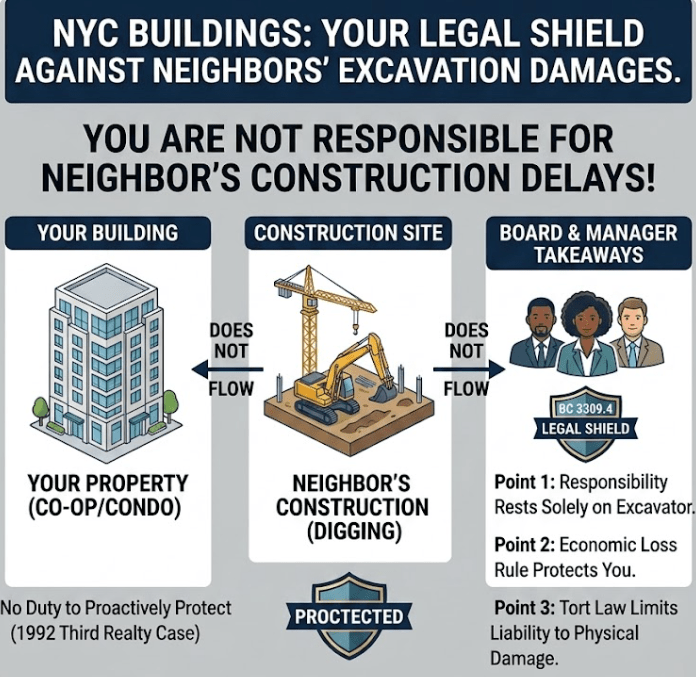
A critical ruling by New York’s Appellate Division (1992 Third Realty LLC v. Third Avenue NY Realty LLC) offers major reassurance: Your building is not responsible for protecting a neighbor’s construction project.

Here is a quick breakdown of the case and the essential takeaways for your board.

The Case: Neighbor Blames Building for Delay Damages

A Manhattan developer began excavation work that, according to the neighboring building owner, caused the adjacent building to lean and settle. The Department of Buildings (DOB) stepped in and issued a stop-work order, directing the developer to halt construction and provide remedial measures to stabilize the neighboring building.

After the building owner sued the developer, the developer fired back with a negligence counterclaim, demanding $16 million in delay damages. Their argument? The existing building should have been designed or retrofitted to handle the neighbor’s future excavation.

On appeal, the Appellate Division reversed the lower court and dismissed the developer’s negligence counterclaim at the pleading stage on two major grounds:

1. No Duty to the Neighbor: A building owner owes zero duty to proactively protect a neighboring developer’s future excavation work.

2. The Burden is on the Digger: Under NYC Building Code § BC 3309.4, the legal responsibility to preserve and protect adjoining structures rests solely on the excavator.

What This Means for Your Board

1. You Are Not an Insurer for Next Door

You do not have to predict future construction next door or alter your property to accommodate it. If a neighbor’s digging damages your building, they are liable for the property damage, not you.

2. The “Economic Loss Rule” Protects You

Even if your building’s condition complicates a neighbor’s excavation, they cannot sue you for purely financial losses (like construction delays or lost profits). Tort law generally restricts recovery to actual physical property damage or bodily injury.

3. The License Request is a Critical Legal Step

By law, the developer must ask you for a “license” (temporary access) to enter your property to install protections, like monitoring equipment or underpinning.

 If they don’t ask: They are still fully liable for any damage they cause.

If they ask: Do not simply ignore or refuse them without legal counsel. While this case confirms the excavator bears the legal burden of protection, a separate body of law (RPAPL 881) governs court-ordered access, so unreasonably blocking a legitimate request can create its own complications.

Quick Action Plan for Managers and Boards

Demand Advance Notice: Developers must give you written notice at least 60 days before starting work that requires property access.

Get a Baseline Inspection: Before they break ground, hire an engineer to document your building’s current condition with photos and video. This is your insurance policy if cracks form later.

Review the Monitoring Plan: Ask for the developer’s engineering plan. They are required to monitor your building’s movement. Consider having your own engineer review it to ensure it is robust enough.

Call the DOB If Needed: If you see structural warning signs (sticking doors, new cracks) and the developer ignores you, contact the DOB immediately. As this case proves, a DOB stop-work order forces the developer to fix the issue at their own expense.

Consult Counsel Early: The moment a developer hands you a license agreement to sign, pass it to your building’s attorney. Never sign a neighbor’s access agreement without legal and engineering review.

Here is the Court’s decision:

1992 Third Realty LLC v. Third Ave NY Realty LLC_2026 N.Y. App. Div. LEXIS 4070Download
Share

About Joseph Colbert, Esq.

With offices in New York and Connecticut, we are ready to handle your legal needs. We have been representing condo, coop and HOA boards, businesses and individual clients for over twenty five years.

You also might be interested in

New York Appellate Court Revives Defamation Claim Against Condominium in Dispute with Unit Owner’s Tenant

New York Appellate Court Revives Defamation Claim Against Condominium in Dispute with Unit Owner’s Tenant

Jun 23, 2024

In a recent decision, the New York Appellate Division, First[...]

Oh No — Condo’s Claims against Sponsor, Time Barred

Oh No — Condo’s Claims against Sponsor, Time Barred

Jul 22, 2020

New condominium, cooperatives and HOA’s have to be mindful about[...]

Coronavirus – Building Volunteers – Yes, No or Maybe?

Coronavirus – Building Volunteers – Yes, No or Maybe?

Mar 25, 2020

With coops, condos and HOAs sheltering in place because of[...]

Recent Attorney Publications

  • When Contractors Lack Licenses: Key Lessons for Condos, Co-ops, and HOAs July 25, 2026
  • When Bankruptcy Won’t Stop Your Foreclosure Sale: What Condo Boards and Management Need to Know About Repeat Filers July 22, 2026
  • When Repetitive Filings Cross the Line: Lessons from Fulton v. Yameogo July 21, 2026
  • Condominium Boards: Why Being Aware of First Mortgage “Standing” Can Protect Your Community’s Bottom Line July 13, 2026
  • Winning the Common Charge Battle: How Condo Boards Prevail Against Defiant Unit Owners July 2, 2026

Contact Us

Send us a note and we'll get back to you promptly.

OFFICES

  • Manhattan Office
  • 315 Madison Avenue, Suite 4032, New York, New York 10017
  • 646.880.3000
  • 646.880.3048
  • Westchester Office
  • 44 South Broadway, 21st Floor, White Plains, New York 10601
  • 646.880.3000
  • 646.880.3048
  • Connecticut Office
  • 55 Post Road W, 2nd Floor, Westport, Connecticut 06880
  • 203.349.8100
  • 646.880.3048

Latest Publications

  • When Contractors Lack Licenses: Key Lessons for Condos, Co-ops, and HOAs July 25, 2026
  • When Bankruptcy Won’t Stop Your Foreclosure Sale: What Condo Boards and Management Need to Know About Repeat Filers July 22, 2026
  • When Repetitive Filings Cross the Line: Lessons from Fulton v. Yameogo July 21, 2026
  • Condominium Boards: Why Being Aware of First Mortgage “Standing” Can Protect Your Community’s Bottom Line July 13, 2026

© 2026 Colbert Law LLC Attorney Advertising. Prior results do not guarantee a similar outcome.

Highend Logo

Manhattan Office

  • 315 Madison Avenue, Suite 4032, New York, New York 10017
  • 646.880.3000
  • 646.880.3048

Westchester Office

  • 44 South Broadway, 21st Floor, White Plains, New York 10601
  • 646.880.3000
  • 646.880.3048

Connecticut Office

  • 55 Post Road W, 2nd Floor, Westport, Connecticut 06880
  • 203.349.8100
  • 646.880.3048

OUR EXPERTISE

When Contractors Lack Licenses: Key Lessons for Condos, Co-ops, and HOAs

July 25, 2026

A recent NYC Civil Court decision (Fortes v. Decorating and...

When Bankruptcy Won’t Stop Your Foreclosure Sale: What Condo Boards and Management Need to Know About Repeat Filers

July 22, 2026

For condominium boards foreclosing on unpaid common charges,...

When Repetitive Filings Cross the Line: Lessons from Fulton v. Yameogo

July 21, 2026

Community association boards—whether governing condos,...

Condominium Boards: Why Being Aware of First Mortgage “Standing” Can Protect Your Community’s Bottom Line

July 13, 2026

When a condominium unit owner defaults on their monthly...

Winning the Common Charge Battle: How Condo Boards Prevail Against Defiant Unit Owners

July 2, 2026

Condominium boards and property managers face a unique,...

When the Neighbor Builds: What Condo and Co-Op Boards Need to Know

June 29, 2026

Construction in New York City is a fact of life, but when a...

Succession Rights in Limited-Equity Co-ops: Practical Lessons from Mutual Redevelopment Houses v. Manyevitch

June 12, 2026

Succession disputes are among the most sensitive and...

The Post-Settlement Trap: What Fiondella Teaches Co-op Boards About Stipulations and Continuing Habitability Claims

June 9, 2026

For New York cooperative boards and managing agents,...

The Derivative Action Threat: Why “Limited Common Elements” Present Litigation Risks for Condominium Boards and Managers

May 16, 2026

A recent decision by the Appellate Division, First...

Governance and Rule-Making in the Modern Condominium

April 27, 2026

Reflections on 10MSW17D LLC v. Bd. of Managers of 10...

Don’t Delay: Why Timely Enforcement of Common Charges is Critical for Condo Boards

April 15, 2026

A recent decision from the Supreme Court of New York,...

RPAPL § 881 Licenses, and Why Fee Reimbursement Is a Core Deal Term

April 13, 2026

Boards and managers of condominiums, cooperatives, and...

The 432 Park Decision: A Masterclass in Risk Management for New York Condo Boards

April 2, 2026

New York condominium boards and management companies operate...

Protecting Your Building’s Integrity: Lessons from Board of Mgrs. of the 80th at Madison Condominium v. 1055 Madison Ave. Owners LLC

March 31, 2026

As a condominium board member or property manager, your...

Press Enter to search · Esc to close