With offices in New York and Connecticut, we are ready to handle your legal needs. We have been representing condo, coop and HOA boards, businesses and individual clients for over twenty five years.
A recent NYC Civil Court decision (Fortes v. Decorating and Painting LLC) serves as a stark reminder for board members and property managers: unlicensed home improvement contractors cannot enforce their contracts or recover payment for their work—period.
Verifying contractor credentials before work begins isn’t just good practice; it’s an essential legal safeguard for your building.
Case Summary: The $50,000 Deposit Dispute
In 2024, Manhattan homeowners signed a $140,800 renovation contract and paid a $50,000 deposit. Crucially, the homeowners stated in writing that work could not begin until all required licenses, permits, and insurance were submitted to management. Despite this, the contractors were allowed into the building and performed demolition work.
When the contractor repeatedly failed to provide the paperwork (including umbrella coverage, worker’s comp, lead paint certificates, and a valid license), the owners terminated the contract.
The Ruling:
The contractor admitted to being unlicensed and submitting incorrect insurance forms.
Under NYC Administrative Code § 20-387, unlicensed contractors are strictly barred from enforcing contracts or recovering compensation—even under quantum meruit (the reasonable value of services provided).
Because the owners explicitly conditioned the start date on valid paperwork, the contractor had no authorization to enter the premises. The court ordered the return of $43,000 (refunding the deposit minus an offset for unapproved demolition work).
5 Critical Lessons for Property Boards, Management and Condo Unit Owners/Coop Shareholders
1. Verify Licensing Before Work Begins
Never take a contractor’s word for it. The NYC Department of Consumer and Worker Protection (DCWP) maintains a searchable online database. Licensing applies to broad renovations—do not let contractors claim they are exempt under a “painting” exception if the scope extends beyond mere decorating.
2. Make Approval Required
Adopt the smart strategy used by the homeowners in Fortes. Update your building’s alteration agreements to provide that work may not commence and contractors may not enter the building until after management has approved all required licenses, permits and insurance for compliance with association rules.
3. Require Complete Insurance & Lead Documentation
Before permitting workers to enter a building, ensure the contractor has adequate insurance such as:
General liability (typically $1M minimum) naming the association as an additional insured.
Statutory Workers’ Compensation and disability benefits.
EPA/NYC lead-paint safety certificates for pre-1960 buildings.
4. Audit Permit Notices
Under NYC Code, contractors must provide written notice detailing required permits and how owners can verify them. Require contractors to supply this notice to management before approving an alteration.
Unit owners or shareholders often don’t realize that hiring unlicensed contractors exposes the entire building to safety hazards and legal risks. Send clear guidelines especially to new owners/shareholders. If an unlicensed contractor is discovered on-site, management should immediately issue a stop-work order and report the contractor to DCWP.
The Bottom Line
Courts will not bail out unlicensed contractors, but a failure to monitor credentials can still lead to building liability, property damage, and delays. Check licenses before the first hammer swings—not after a dispute starts.
For condominium boards foreclosing on unpaid common charges, it’s common to see a unit owner file for bankruptcy right before a scheduled auction and claim the sale must stop. Bankruptcy often does pause a foreclosure—but there are real limits, especially when the owner has filed and dismissed multiple cases in a short period. With the right strategy, boards can often keep a sale moving forward.
The MTGLQ Investments Decision: A Useful Example
In MTGLQ Investments, L.P. v. Emego, a borrower filed bankruptcy one day before a scheduled foreclosure sale, then tried to undo the sale afterward. The court refused. It held that the bankruptcy filing did not automatically stop the sale because the borrower had a recent pattern of bankruptcy cases that had been dismissed.
In plain terms: the owner assumed that filing again would automatically freeze everything. The court said it didn’t work that way under these facts.
What Happens When an Owner Files Over and Over
Most people know that a bankruptcy filing usually triggers an “automatic stay” that temporarily stops collection and foreclosure activity. But repeat filings can change that.
In this case, the court focused on the owner’s prior bankruptcy history and found that, because of multiple recent dismissed cases, the usual automatic stay never started at all. That meant the foreclosure sale could proceed, and the deed issued after the sale remained valid.
The Owner Can Still Ask for Protection—But It’s Not Automatic
Even when the automatic stay does not apply, a unit owner may still ask the bankruptcy court to impose a stay. But that requires an actual request and a court order—and timing is everything.
In MTGLQ, there was no showing that the owner obtained any court-ordered stay before the auction. Without a stay in place before the sale, the owner could not use the bankruptcy filing to unwind what happened.
Practical Takeaways for Condo Boards
As experienced condo and bankruptcy counsel, these are some of the things we do when prosecuting a common charge line foreclosure for our condo boards:
Check for prior bankruptcy filings early. Repeat filings may limit or eliminate the owner’s ability to stop a sale automatically.
Check the details of the owner’s bankruptcy filing history.
Watch the bankruptcy docket closely. If the owner tries to get a court-ordered stay, we are ready to respond quickly.
Coordinate with the referee and other sale participants. Clear communication reduces confusion and prevents unnecessary adjournments.
Why Experienced Counsel Matters
These issues sit at the intersection of foreclosure procedure and bankruptcy rules. Boards benefit from counsel who can quickly evaluate whether a new bankruptcy filing actually stops a scheduled sale, and who can guide the board, the referee, and other parties through the correct next steps.
A bankruptcy filing can be a powerful delay tactic—but not always. MTGLQ is a reminder that courts will enforce limits on repeat filings, and that a board with experienced counsel may be able to proceed with a foreclosure sale even when the owner files at the last minute.
Community association boards—whether governing condos, HOAs, or co-ops—frequently deal with difficult residents. While owners have a right to challenge board decisions, that right isn’t unlimited.
A New York decision, 2104 Fulton, LLC v. Yameogo, highlights how courts respond when an individual moves past vigorous advocacy into abusive, repetitive litigation designed purely to obstruct. Here is what happened, and how association boards can use these principles to handle bad-faith litigants.
What Happened in Fulton v. Yameogo?
Though Fulton began as a commercial lease dispute, its lessons apply to any board dealing with serial filers:
The Pattern: A tenant facing eviction filed six separate orders to show cause across two courts to delay the process.
The Recycled Arguments: In every filing, he repeated the exact same claims (alleging forged lease documents and health code violations) that the court had already rejected.
The Warning Ignored: The court explicitly warned the tenant that his claims were barred, sanctioned him $100, and cited his abuse of the process. He ignored the warning and filed another motion after the eviction was already completed.
The court ruled his conduct frivolous, found he engaged in a deliberate strategy to delay, and hit him with legal sanctions.
The Legal Framework: When Does Advocacy Become Abuse?
Courts recognize a constitutional right to petition for relief, but they also hold inherent authority to stop litigants who act in bad faith.
Single Lawsuits vs. Patterns: To prove a single lawsuit is a “sham,” it must be completely baseless. However, when evaluating a series of filings, courts look at the holistic pattern. A stream of repetitive, unsuccessful filings evidences an intent to abuse the judicial system rather than seek genuine justice.
Collateral Estoppel (Issue Preclusion): Repeating claims that have already been thrown out by a Court, transitions a case from aggressive defense to illegal harassment.
4 Red Flags of Abusive Resident Conduct
Boards dealing with difficult owners should watch for these signs of bad-faith litigation:
Repetition: Raising the exact same grievance after it has been formally decided or dismissed.
Lack of Legal Merit: Filings that ignore governing documents, statutes, or established facts.
Motive to Obstruct: Using procedural delays to drain association resources, harass management, or delay valid board actions.
Ignoring Rulings: Continuing to file claims despite prior adverse decisions or official warnings.
Practical Steps for Boards
If a resident enters a cycle of repetitive, meritless claims, boards should take these five proactive steps:
Document Everything: Keep a detailed, chronological record of every filing, appeal, written ruling, and warning showing the pattern.
Leverage Governing Documents: Review your bylaws with legal counsel. Look for clauses that limit appeal attempts, allow attorney fee recovery for frivolous actions, or impose fines for disruptive conduct.
Seek Sanctions: When litigation is involved, ask the court for monetary penalties, attorney’s fees reimbursement, or an injunction barring the owner from making further filings without prior court approval.
Proceed with Caution
Sanctions are reserved for severe cases. A single aggressive filing or an unsuccessful good-faith argument does not qualify as abuse. Boards must never use threats of sanctions to suppress legitimate dissent. Work closely with association counsel to ensure you are protecting community resources without infringing on owner rights.
When a condominium unit owner defaults on their monthly common charges, the board’s primary tool for recovery is filing and foreclosing on a common charge lien. However, condominium boards routinely run into a frustrating roadblock: the priority of the first mortgage. Under standard real estate law, a bank’s first mortgage typically takes priority over a condo’s common charge lien. Because bank foreclosures can end with the bank taking back the property at auction—or with no surplus funds left over after the bank’s debt is paid—condominiums don’t get paid and have to resort to other tools to recover against the foreclosed unit owner.
But it doesn’t always have to be a dead end.
While challenging a bank’s mortgage priority is not a routine or mandatory requirement for every foreclosure, sophisticated condominium boards should be aware that it is a viable legal possibility. By understanding the mechanics of bank foreclosures and engaging experienced legal counsel, boards can evaluate whether a bank’s claim to primary priority is actually valid, or if the condo’s common charge lien has a chance to step into the winner’s circle.
The Power of Priority: A Possibility Worth Investigating
In a typical foreclosure scenario, a bank’s first mortgage must be satisfied before any junior liens receive a dime. If a unit goes to a foreclosure auction and the sale price doesn’t exceed the bank’s loan amount, there is no “surplus,” and the condominium board doesn’t get back from the foreclosure. There are other ways to get paid but the foreclosed unit is no longer available to secure the unit owner’s debt to the condominium.
However, a mortgage is only enforceable if the entity bringing the foreclosure action has the legal right to do so. In real estate litigation, this is known as standing. To have standing in a mortgage foreclosure action, a bank must prove that it was the actual holder or assignee of the underlying promissory note at the exact moment the lawsuit was commenced.
Because banks frequently bundle, sell, and transfer mortgages through complex securitization pools, critical paperwork—like the original note, assignments, and powers of attorney—is sometimes misplaced or improperly executed. If a bank files a foreclosure action but cannot prove it legally held the note on day one, its foreclosure can fail. For a condominium board, if a bank cannot establish standing, its priority claim is compromised, opening up the rare but powerful possibility that the condo’s common charge lien could move into the primary position to collect what is owed.
A Lesson from the Courts: U.S. Bank N.A. v. Speller
A decision from the New York Appellate Division, U.S. Bank N.A. v. Speller, perfectly illustrates just how heavily litigated and technically demanding the issue of a bank’s standing can be.
In the Speller case, U.S. Bank commenced a mortgage foreclosure action against individual unit owners. The defendants raised the affirmative defense that the bank suffered from a lack of standing. The trial court initially agreed with the defendants, taking the drastic step of dismissing the bank’s complaint entirely.
While U.S. Bank ultimately won on appeal by bringing in meticulous testimony from a third-party note custodian and producing pristine business records to prove they physically possessed the original note at commencement, the case highlights a critical lesson: a bank’s standing is not a foregone conclusion. The bank had to endure a full trial and a subsequent appellate battle just to prove it had the right to foreclose.
The Crucial Role of Experienced Counsel
Navigating the intersection of condominium law and mortgage foreclosure litigation is highly technical. It is not something a board should look into without guidance, nor is it a strategy to deploy blindly in every case. Instead, this is a tool for your legal arsenal to be evaluated with experienced counsel.
An experienced condominium attorney can help your board by:
Evaluating the Risks and Rewards: Reviewing the bank’s initial filings to look for glaring chain-of-custody gaps or missing note endorsements.
Determining Feasibility: Assessing whether a bank’s potential standing issue is weak enough to warrant a formal legal challenge, ensuring the board does not waste community funds on fruitless litigation.
Protecting the Association’s Interesets: Keeping a watchful eye on the bank’s foreclosure timeline and ensuring the condo is positioned to capture any unexpected surplus if the property does sell.
When a bank takes back a property because there are no external buyers at an auction, the condominium is usually left holding the bag for months or years of unpaid common charges. While you cannot challenge every first mortgage, simply being aware that a bank’s priority depends entirely on its legal standing changes the dynamic. By working closely with experienced counsel to spot these unique opportunities, condominium boards can aggressively protect their communities’ financial health and ensure they aren’t leaving money on the table.
Condominium boards and property managers face a unique, often frustrating hurdle when trying to collect unpaid common charges: the unit owner counterclaim. When a board takes legal action to recover delinquent dues, it is common for the owner to push back with a laundry list of defenses and counterclaims to delay payment.
A recent post-trial decision from the New York County Supreme Court provides a vital playbook for boards on how to successfully navigate these disputes, crush frivolous counterclaims, and fully protect their building’s financial health.
The Breakdown: From Scattershot Defenses to a Complete Post-Trial Victory
In this case, a board of managers sought to collect unpaid common charges, assessments, water charges, late fees, and interest from a long-delinquent unit owner. Rather than paying, the owner retaliated by asserting eleven affirmative defenses and a counterclaim, challenging the board’s accounting and the validity of capital assessments for major building repair projects.
While the court initially handles early motions by narrowing down issues, this matter proceeded to a full bench trial. The result was an absolute victory for the condominium board. Following a multi-day trial, the court systematically dismantled the owner’s defenses, explicitly ruling that:
The Business Judgment Rule Protects Board Decisions: The court deferred to the board’s good-faith choices to replace an aging elevator and repair the building’s structural roof. The owner could not escape his financial obligations simply because he disagreed with the cost or scope of the work.
Professed Ignorance is No Shield: The court rejected the owner’s claims that he lacked information or hadn’t read the bylaws, noting that an owner cannot enjoy the economic benefits of a unit—including generating unapproved Airbnb rental income—while refusing to pay the common charges keeping the building afloat.
The Entire Ledger is Enforceable: Because the underlying assessments were valid, the owner’s attempt to use an accounting expert to reduce his bill was rejected. The court ordered the owner to pay all outstanding balances, interest, and late charges.
The core takeaway is clear: owners cannot use scattershot legal tactics or stall strategies to avoid their primary financial obligations to their neighbors.
Your Toolkit: Powerful Collection Mechanisms Under New York Law
New York law equips boards with robust statutory weapons to combat non-payment. When properly leveraged by experienced counsel, these legal tools ensure that delinquent owners—not the rest of the paying residents—bear the burden of unpaid expenses.
The Statutory Lien: The board of managers possesses an automatic statutory lien on a unit for any unpaid common charges and interest. This lien is incredibly powerful because it takes priority over almost all other liens, except for municipal taxes, a primary first mortgage, or specific government-backed subordinate mortgages.
Dual-Track Recovery: Boards generally do not have to choose between a lengthy foreclosure process and a standard debt collection lawsuit. Depending on what your bylaws permit, you can simultaneously pursue a money judgment while maintaining your lien rights.
Recovering Hidden Costs: Beyond base common charges, a properly drafted statutory lien and complaint can include interest, late fees, and—crucially—attorney’s fees. In this post-trial ruling, the court explicitly found the board to be the prevailing party and ordered the owner to pay the association’s legal fees.
Key Takeaways for Boards and Property Managers
To ensure your building is in the best position to win a collection dispute at trial, keep these proactive legal strategies in mind:
Review Your Bylaws Early: Your ability to recover late fees and the steep legal fees spent chasing a delinquent owner depends heavily on the language in your governing documents. Some bylaws also explicitly require condo boards to aggressively pursue arrears as part of the board’s fiduciary duty.
Keep Meticulous Ledgers: Cases are won or lost on documentation. Accurate, contemporaneous accounting of common charges, late fees, and professional management records makes it much easier for your legal team to prove its prima facie case and dismiss a defendant’s counterclaims quickly.
Act Decisively: Allowing arrears to accumulate without recording a lien or initiating legal action weakens the board’s financial health. It also complicates recovery if a first mortgage lender steps in to foreclose.
Given the technical requirements of collection litigation and the potential for bad-faith counterclaims challenging board authority, engaging experienced condominium counsel early in the collection process is essential.
Here is the Board of Managers of the 5 E. 17th St. Condominium v. Peck decision:
Construction in New York City is a fact of life, but when a neighboring developer starts digging, boards and property managers understandably worry about structural damage and liability.
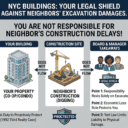
A critical ruling by New York’s Appellate Division (1992 Third Realty LLC v. Third Avenue NY Realty LLC) offers major reassurance: Your building is not responsible for protecting a neighbor’s construction project.
Here is a quick breakdown of the case and the essential takeaways for your board.
The Case: Neighbor Blames Building for Delay Damages
A Manhattan developer began excavation work that, according to the neighboring building owner, caused the adjacent building to lean and settle. The Department of Buildings (DOB) stepped in and issued a stop-work order, directing the developer to halt construction and provide remedial measures to stabilize the neighboring building.
After the building owner sued the developer, the developer fired back with a negligence counterclaim, demanding $16 million in delay damages. Their argument? The existing building should have been designed or retrofitted to handle the neighbor’s future excavation.
On appeal, the Appellate Division reversed the lower court and dismissed the developer’s negligence counterclaim at the pleading stage on two major grounds:
1. No Duty to the Neighbor: A building owner owes zero duty to proactively protect a neighboring developer’s future excavation work.
2. The Burden is on the Digger: Under NYC Building Code § BC 3309.4, the legal responsibility to preserve and protect adjoining structures rests solely on the excavator.
What This Means for Your Board
1. You Are Not an Insurer for Next Door
You do not have to predict future construction next door or alter your property to accommodate it. If a neighbor’s digging damages your building, they are liable for the property damage, not you.
2. The “Economic Loss Rule” Protects You
Even if your building’s condition complicates a neighbor’s excavation, they cannot sue you for purely financial losses (like construction delays or lost profits). Tort law generally restricts recovery to actual physical property damage or bodily injury.
3. The License Request is a Critical Legal Step
By law, the developer must ask you for a “license” (temporary access) to enter your property to install protections, like monitoring equipment or underpinning.
If they don’t ask: They are still fully liable for any damage they cause.
If they ask: Do not simply ignore or refuse them without legal counsel. While this case confirms the excavator bears the legal burden of protection, a separate body of law (RPAPL 881) governs court-ordered access, so unreasonably blocking a legitimate request can create its own complications.
Quick Action Plan for Managers and Boards
Demand Advance Notice: Developers must give you written notice at least 60 days before starting work that requires property access.
Get a Baseline Inspection: Before they break ground, hire an engineer to document your building’s current condition with photos and video. This is your insurance policy if cracks form later.
Review the Monitoring Plan: Ask for the developer’s engineering plan. They are required to monitor your building’s movement. Consider having your own engineer review it to ensure it is robust enough.
Call the DOB If Needed: If you see structural warning signs (sticking doors, new cracks) and the developer ignores you, contact the DOB immediately. As this case proves, a DOB stop-work order forces the developer to fix the issue at their own expense.
Consult Counsel Early: The moment a developer hands you a license agreement to sign, pass it to your building’s attorney. Never sign a neighbor’s access agreement without legal and engineering review.
The key lesson from this new Second Department Appellate Court decision is that condominium boards, supported by their property management, must maintain detailed and objective records demonstrating a good faith effort to investigate, enforce, and balance the interests of all unit owners according to the governing documents. Boards can’t just say that it’s a unit owner-unit owner dispute and leave the owners to deal with their differences. A condominium board investigation and intervention, if deemed appropriate, should be undertaken.
The dispute in the case centers on a condominium unit owner’s complaints that a neighboring unit’s use was violating the building’s bylaws and house rules, specifically alleging a purported breach and resulting in unreasonable traffic and commotion in the common area hallway.
Key Board Obligations Under Scrutiny
The Appellate Division found that the plaintiffs raised issues of fact as to whether the defendant-Board of Managers breached its fiduciary duty by “permitting a purported breach of the bylaws and house rules to persist” over the plaintiffs’ repeated complaints.
The court noted that the parties provided “sharply contrasting evidence” concerning the extent of the Board’s investigation into the complaints and whether it fulfilled its fiduciary obligation to enforce the condominium bylaws.
Even though “persons living in organized communities must suffer some damage, annoyance and inconvenience from each other”, this principle does not eliminate a board’s duty to investigate alleged violations and “balance the unit owners’ rights fairly without favoring one over the other”.
An issue of fact was raised as to whether the Board properly determined that the neighbor’s conduct did not create a nuisanceunder the bylaws and house rules.
Dismissed Claims and Allegations
The Appellate Court upheld the dismissal of the following allegations and claims:
Retaliation/Disparate Treatment: The court agreed that the Board’s enforcement of a neutral rule—such as demanding the removal of the plaintiffs’ Ring camera—does not, on its own, establish disparate treatment or support a breach of fiduciary duty claim based on allegations of being singled out or retaliated against.
Private Nuisance: The court properly dismissed the claim for private nuisance against the Board because the Board “was not responsible for the creation of the purported nuisance”.
Takeaways for Boards and Management
This case provides critical guidance on a Board’s responsibilities when faced with unit owner complaints about a neighbor’s conduct:
Due Diligence in Investigation: When a unit owner alleges a violation of bylaws or house rules, the Board has a fiduciary duty to thoroughly investigate the complaint. Simply making a determination without a provable, complete, and fair investigation may be challenged in court.
Fair and Balanced Enforcement: The Board’s duty includes balancing the rights of all unit owners and acting fairly, “without favoring one over the other”. If the Board determines a neighbor’s conduct is not a violation, the record of the investigation should clearly support that decision.
Board Liability for Nuisance is Limited: A board is generally not liable for a private nuisance unless it was responsible for creating the nuisance itself.
A recent decision from the Supreme Court of New York, Appellate Division, Second Department, in Board of Managers of Mountainside Hills Condominium II v. Pantaleone, provides important guidance and reassurance for condominium boards in New York seeking to enforce settlement agreements against delinquent unit owners. The Appellate Division affirmed the Supreme Court’s denial of the defendants’ motion to vacate a clerk’s judgment, ultimately upholding the condo board’s successful enforcement of a settlement stipulation for unpaid common charges. This case highlights the importance of strict adherence to contract terms and clarifies the application of the New York CPLR regarding service by mail.
Key Facts of the Case
The case began with the Board of Managers suing the unit owners (the defendants) to recover unpaid common charges and related fees.
The Stipulation: The parties entered into a so-ordered stipulation of settlement that required the unit owners to make installment payments to satisfy the agreed-upon amount.
The Default Provision: The stipulation specifically provided that if the owners failed to make any payment, the Board had the right to seek the entry of a judgment.
The Cure Requirement: Crucially, before seeking judgment, the stipulation required the Board to first serve the owners with a notice to cure. This notice had to be sent via:
Email to the owners’ attorney.
First-class mail directly to the owners.
The Board could seek judgment only after seven days elapsed following delivery of the notice through both means of service.
The Failure to Pay: The unit owners failed to make an installment payment due on November 1, 2019.
The Board’s Action: On November 7, 2019, the Board sent the required notice to cure via email to the owners’attorney and via first-class mail to the owners.
The Judgment: After the owners failed to cure the default, the Board submitted a proposed judgment, and a clerk’s judgment of $78,111.02 was entered on November 20, 2019.
The Court’s Ruling and Key Takeaways
The unit owners later moved to vacate the judgment, claiming they did not receive the notice to cure. However, theAppellate Division rejected their argument, basing its decision on well-established legal principles regarding proof of mailing and contract enforcement.
1. The Rebuttable Presumption of Receipt by Mail
The Court reinforced the powerful legal presumption regarding service by mail under New York law:
Proof of Mailing: Under New York law, submitting a properly executed affidavit of service creates a rebuttable presumption that the item was received by the addressee.
CPLR 2103(b)(2) Extension: The Appellate Division specifically applied the five-day extension provided by CPLR 2103(b)(2). Because the Board’s affidavit of service established the notice was mailed on November 7, 2019, the owners were presumed to have received it on November 12, 2019 (five days after mailing).
Denial is Not Enough: The Court held that the owners’“mere denial of receipt was insufficient to rebut that presumption.”
2. Strict Adherence to the Contract
The Court treated the stipulation of settlement as a contract, enforceable according to its terms.
The stipulation required the Board to wait seven days after delivery before seeking judgment.
Since the presumed date of receipt was November 12, 2019, the Board was permitted to seek judgment seven days later, on November 19, 2019.
By submitting the proposed judgment on November 19, 2019, the Board complied with the terms of the stipulation, and the judgment was correctly entered.
Actionable Advice for Condo Boards
This case serves as a vital blueprint for New York condominium boards when negotiating and enforcing settlement agreements for common charge arrears.
1. Be Meticulous in Drafting Stipulations
Define “Service”: Ensure your stipulations clearly and unambiguously define the method and date of service for a notice to cure. Include multiple, verifiable methods such as both certified and first-class mail, or email to a specific address, as the Mountainside Hills Board did.
Specify the “Cure Period”: Clearly state the exact cure period (e.g., seven days) and, critically, when that period begins (e.g., “seven days after delivery” or “seven days after the presumed date of receipt”). If you can omit a cure period, it is better to do so.
2. Follow Service Requirements Exactly
Affidavits are Essential: Always obtain and retain a properly executed affidavit of service when mailing a notice to cure. This is the evidence needed to create the powerful legal presumption of receipt, as a simple denial by the owner will not defeat it.
Account for the 5-Day Extension: When calculating the deadline to seek judgment, remember that New York’s CPLR 2103(b)(2) adds five days to the mailing time for court-mandated periods. The Board in this case correctly calculated the date of presumed receipt.
3. Enforce Judgments Promptly
A stipulation of settlement is a contract, and when the unit owner breaches, the Board is entitled to enforce the agreed-upon remedy.
As long as the Board can prove it strictly followed all notice and timing requirements in the stipulation, a court is likely to enforce the judgment and uphold the collection efforts against the delinquent unit owner.
Condominium boards should work closely with experienced legal counsel to draft ironclad settlement agreements and meticulously document every step of the notice process to ensure they can swiftly and successfully enforce them in the event of a default. Here’s the Court’s decision.
Community association boards, whether governing condominiums or cooperatives, bear the responsibility of maintaining community harmony, enforcing governing documents, and safeguarding both the financial stability and reputation of their associations. This duty faces its greatest test when a single, highly disruptive unit owner threatens the community’s well-being. The recent New York case, Board of Managers of Two Waterline Square Condominium v. Botach, exemplifies the difficult choices facing condominium boards when dealing with allegedly egregious owner conduct—and illustrates how aggressive legal action, while sometimes necessary, can expose associations to significant public scrutiny and legal risk.
The Two Waterline Square Conflict: A Case Study in Condominium Management
The lawsuit filed by the Board of Managers of Two Waterline Square Condominium against Jacob Botach (aka Rabbi Shmuley Boteach) and Deborah Botach originated from a dispute over $1,420 in rental and cleaning fees, plus late charges, for the unauthorized use of a common room in May and September 2024.
The conflict escalated dramatically when Defendant Botach refused to pay the fees, claiming the Board’s enforcement constituted anti-Semitism because one unauthorized use was for a memorial service honoring a victim of the October 7, 2023 Hamas attack. According to the Board’s allegations, Botach subsequently launched a public campaign against the association, utilizing emails to unit owners and social media posts (reaching his over 900,000 followers) that contained what the Board characterizes as “hyperbolic, defamatory, and frankly offensive” content. The complaint details three primary legal claims:
Defamation: Botach allegedly likened the $710 fee to historical persecution, including the Holocaust and Nazi Germany forbidding Jewish funerals, and called the Board “corrupt” and “antisemitic”.
Harassment/Nuisance: The complaint details Botach’s alleged harassment of Board members and building staff, including shouting at staff in the lobby, accusing them of “illegal activity and corruption,” and threatening “we are coming after you big time”.
Breach of Contract: Failure to pay the common room fees and associated late fees, which constitutes a material breach of the Condominium Documents.
The Board seeks not only the unpaid fees but also a Permanent Injunction to stop Botach from continuing his disruptive behaviors and publishing allegations of religious animus, as well as Exemplary Damages for defamation.
The Critical Distinction: Condominiums vs. Cooperatives
Understanding the fundamental differences between condominium and cooperative governance structures is crucial for boards contemplating litigation. These structural distinctions significantly impact both available remedies and strategic considerations.
Feature
Cooperative (Co-op)
Condominium (Condo)
Ownership
Shareholder in a corporation; holds a proprietary lease.
Owner of the unit (real property); holds a deed.
Relationship
Landlord-Tenant
Owner-Association
Primary Remedy
Eviction. The proprietary lease allows the board, in extreme cases, to terminate the tenancy of a disruptive shareholder.
Injunction & Foreclosure. The board must rely on remedies of property owners, such as filing a lien for unpaid charges and pursuing foreclosure or seeking injunctive relief for nuisance.
This fundamental difference in ownership structure creates distinct challenges for condominium boards. Unlike cooperative boards, which can leverage the landlord-tenant relationship to pursue eviction as an ultimate remedy, condominium boards must rely on remedies available to property owners dealing with other property owners. This limitation typically requires pursuing more expensive, time-consuming, and publicly visible litigation—including foreclosure actions for unpaid assessments or, as demonstrated in the Botach case, claims for private nuisance, defamation, and injunctive relief.
The Double-Edged Sword: Legal Action and Liability Exposure
While a board must act to stop an owner whose conduct interferes with the quiet enjoyment of other residents, pursuing a high-profile case like Two Waterline Square v. Botach comes with serious risks:
1. Public Scrutiny and Damage to Property Values
High-profile litigation, particularly cases involving public figures and inflammatory allegations such as discrimination claims, can severely damage a community’s reputation and market appeal. Properties in communities perceived as contentious, financially unstable, or poorly managed typically experience decreased buyer interest and reduced market values.
Financial Impact: Litigation can result in high legal fees, which may require special assessments or increases in common charges, making units less attractive to buyers. A protracted legal battle creates financial uncertainty, which can make it difficult for buyers to obtain financing, further reducing the pool of potential purchasers and decreasing property values.
2. Risk of Counterclaims and Board Liability
An aggressive lawsuit often invites counterclaims from the defendant, which can expose the board and individual directors to liability, even if they acted in good faith. Directors and Officers (D&O) insurance is critical here, as it typically covers the legal defense costs associated with defending against harassment and defamation allegations.
In consideration of the defamation claims asserted by the Board against Defendant Botach, it was crucial for the board to have considered the potential for Strategic Lawsuit Against Public Participation (SLAPP) counterclaims by Botach against the Board. Given Botach’s public figure status and his substantial following, the Board’s defamation claims may be perceived as an attempt to stifle his exercise of free speech. This raises the risk of SLAPP counterclaims, which, if successful, could lead to the dismissal of the Board’s defamation claims and the imposition of significant legal fees and penalties against the Board. Therefore, the Board should have carefully evaluated the merits of its defamation claims before asserting them and considered the potential ramifications of SLAPP statutes, which are designed to protect individuals from legal actions intended to chill their First Amendment rights.
Conclusion
The Two Waterline Square case illustrates the challenging position condominium boards face when traditional enforcement mechanisms prove insufficient to address disruptive owner behavior. Unlike cooperative boards with eviction remedies, condominium boards must carefully weigh the costs and risks of public litigation against the imperative to protect community interests. Before pursuing aggressive legal action, boards should conduct thorough cost-benefit analyses that consider not only the immediate dispute but also potential reputational damage, financial exposure, and the precedent such action may set within the community. The board’s attorney should take the board through this evaluation in advance of such aggressive and expensive and consequential legal action.
Effective community governance requires boards to maintain consistent, transparent, and legally compliant enforcement practices while fully understanding their structural limitations. When confronting egregious owner conduct, boards must develop comprehensive strategies that address immediate concerns while minimizing long-term risks to the community. This includes ensuring adequate Directors and Officers insurance coverage, consulting with experienced counsel, and carefully documenting all enforcement decisions. While taking a principled stand may sometimes be necessary to fulfill fiduciary duties, the strategy must be carefully calibrated to protect—rather than inadvertently harm—the community the board serves.
New York City’s skyline is dotted with condominiums, each housing a unique community with its own set of rules and challenges. Disputes often arise between condo owners and the boards of managers tasked with overseeing the building’s operations. These disputes can range from breach of contract claims to allegations of fraud and misrepresentation. This blog post examines a series of recent court decisions addressing a variety of legal issues arising in the context of New York City condominiums.
Breach of Contract and Construction Defects:
Several cases involved claims related to construction defects and alleged breaches of contract. In these instances, the courts analyzed the offering plans, purchase agreements, and other governing documents to determine the sponsor’s obligations and the unit owners’ rights.
In Board of Managers of 45 East 22nd Street Condominium v. 45 East 22nd Street Property LLC, the court considered claims of breach of contract and fraud in connection with the sale of a unit. The court ultimately denied the defendants’ motions to dismiss, allowing the case to proceed to discovery.
In Board of Managers of the Aston Condominium v. Building 389 LLC, the Appellate Division, First Department, addressed a case involving alleged construction defects and insufficient water heater warranties. The court partially dismissed the breach of contract claim related to construction defects due to a notice requirement in the offering plan. However, the court allowed the breach of contract claim based on the water heater warranties and the fraudulent conveyance causes of action to proceed.
In Board of Managers of the Blackfriars Condominium v. AG Ebenezer LLC, the court addressed a variety of claims, including significant construction defects, failure to preserve tax-exempt status for the church, and failure to honor financial commitments. The court dismissed several claims but allowed others to proceed, highlighting the complexity of legal issues that can arise in condominium development and management.
Piercing the Corporate Veil:
In Board of Managers of 135 West 52nd Street Condominium v. 135 West 52nd Street Owner LLC, the court addressed the issue of piercing the corporate veil to hold the sponsor’s principals personally liable for alleged construction defects. The court found the allegations insufficient to pierce the corporate veil, emphasizing the need for detailed and specific claims to hold individuals liable for the actions of a corporate entity.
Common Charges and Liens:
In Board of Managers of 25 Prince Street Condominium v. NYC Prince Holdings LLC, the Appellate Division, First Department, dealt with a dispute over unpaid common charges and a lien on a commercial unit. The court granted summary judgment to the board of managers on its claims for foreclosure on the lien, breach of contract, and attorneys’ fees. The court also declared that the roof was a general common element for which the defendant was responsible.
These cases provide a glimpse into the diverse legal issues that can arise in condominium disputes. They underscore the importance of carefully drafted offering plans, purchase agreements, and other governing documents. The decisions also highlight the need for boards of managers and unit owners to be aware of their rights and obligations under New York law.