• Home
  • About us
  • Capabilities
    • Condo, Coop, HOA Counsel
    • Litigation
    • Business Law
    • Technology
    • Real Estate
    • Employment Law
    • Tax Audits
    • Family Law
  • Insights
  • References
  • FAQ
  • Inquiry
    • Payment
Colbert LawColbert Law
  • Home
  • About us
  • Capabilities
    • Condo, Coop, HOA Counsel
    • Litigation
    • Business Law
    • Technology
    • Real Estate
    • Employment Law
    • Tax Audits
    • Family Law
  • Insights
  • References
  • FAQ
  • Inquiry
    • Payment

Litigation

Home Litigation (Page 10)
Condo Common Charge Lien Foreclosure is Sometimes Necessary – Don’t Stop at That

Condo Common Charge Lien Foreclosure is Sometimes Necessary – Don’t Stop at That

Common charge lien collection sometimes takes a long time and even more so during a pandemic. But, in the end condo boards may have to pull the trigger on foreclosure. Deals can be negotiated during the process while the heat is turned up on delinquent owners, or a new owner who can pay their share of common charges can be substituted once foreclosed. The foreclosure process takes time, but in the end it may be the only way to resolve delinquencies.  There are nuances that a condo board can take advantage of during the process and experiences counsel can guide you through them. 

Common charge lien collection sometimes takes a long time and even more so during a pandemic. But, in the end condo boards may have to pull the trigger on foreclosure. Deals can be negotiated during the process while the heat is turned up on delinquent owners, or a new owner who can pay their share of common charges can be substituted once foreclosed. The foreclosure process takes time, but in the end it may be the only way to resolve delinquencies.  There are nuances that a condo board can take advantage of during the process and experiences counsel can guide you through them. 

The 4260 Broadway Condominium case is a good example. In the beginning of 2019, the condo board was faced with a unit owner with over $10k in arrears. A common charge lien was filed. A few months later,  a foreclosure action started.  A lot of paperwork followed and then a year later the court just issued a decision granting a default against the owner for not responding and the process goes on. Here is the decision. Getting caught in the process and just forging ahead without taking advantage of other things a condo board and management can be doing while the process goes on and on, would be a mistake. 

Oh No — Condo’s Claims against Sponsor, Time Barred

Oh No — Condo’s Claims against Sponsor, Time Barred

New condominium, cooperatives and HOA’s have to be mindful about time and rights vis-a-vis the sponsor. Statutes of limitations are the time that an association has to bring a lawsuit to assert claims, before the claims become time-barred.  It is often the easiest defense for a sponsor to end a lawsuit.

The 23-23 Condominium found this out the hard way by having almost all of its action against the sponsor for construction defects, dismissed on a summary judgment motion.  The Second Department explained that a “claim for damages arising from defective construction accrues on the date of completion of the work”.  If the time limit for bringing the claim has expired, then the plaintiff is out of luck.

The Governor issued Executive Orders tolling the statute of limitations for claims in New York for a particular period of time.  Make sure that you calculate in that tolling period and add it to your statute of limitations.  Whatever you do, don’t wait too long to find out that the sponsor is off the hook and your association’s owners are left holding the bag.

Here is the decision.

US Government Enforces Laws re Assistance Animals and Warns Coops and Condos

US Government Enforces Laws re Assistance Animals and Warns Coops and Condos

The United States government decided to prosecute an assistance animal discrimination case.  Acting United States Attorney Of the SDNY in Manhattan: “This is yet another lawsuit brought to enforce the rights of tenants with disabilities to live with an assistance animal. With this resolution, we again emphasize that condominiums, cooperatives, landlords, and property managers are required by federal law to provide reasonable accommodations to people with disabilities.”  Coops, condos and property managers have to be careful when owners request to have an assistance animal. Solid legal advice is critical.

Read more. 

People fight over the Darnedest Things – a Coop Parking Spot

People fight over the Darnedest Things – a Coop Parking Spot

Fighting over a cooperative parking space. Court’s often grant preliminary injunctions to get the parties to seriously consider settling. This case by a coop shareholder against Cherry Lane Owners Corp. is crying out to be settled.

Mold – Have to Act Quick and Tee Up Your Condo’s or Coop’s Defense

Mold – Have to Act Quick and Tee Up Your Condo’s or Coop’s Defense

Water damage + mold growth = lawsuit for damages.  Condominiums and cooperatives have to deal with water damage all the time.  When it happens, even when action is taken immediately to mediate, there may be mold growth that will eventually rear its ugly head.  Where there is mold, you’ll probably find a plaintiff and an tort attorney looking for money.

Knowing this, it is important to prepare to have to defend the association. If an insurance adjuster is involved, they’ll probably be lot’s of information gathered and pictures taken.  The association is best advised to document what is happening and have its own record. 

Once you know a lawsuit is coming, retaining an expert is critical at the earliest juncture to sustain and defense and extricate the association from the lawsuit as soon as possible.  If defense counsel is not recommending an expert early on, bring the request to counsel’s attention.

The Board of Managers of Forestal Condominium retained a clinical neuropsychologist expert but failed to retain an expert to address the complainant’s symptoms other than neurological ones.  For example, plaintiff complained that the presence of T-2 Toxin Trichothecene caused plaintiff injury.  The Court explained that if the condo had presented the right expert testimony on the motion, the condo might have been out on summary judgment. Because the condo didn’t have an expert teed up and ready to testify, the condo is now stuck in the lawsuit through trial.  

Click here to read the recent Davydov v. Board of Managers of Forestal Condominium decision.

Quarantine Violation Penalties – Condo and Coops Could be Next

Quarantine Violation Penalties – Condo and Coops Could be Next

New York, Connecticut and New Jersey have self-quarantine requirements.  New York’s Governor just issued an executive order imposing penalties and possible jail time for violators who go to hot spot states and then don’t self-quarantine as required.  Are coops and condos the next targets.  The government went after them when trying to control illegal short term rentals, they may go after condos and coops who don’t make sure their renters comply.  We’ll have to wait and see.

[embedyt] https://www.youtube.com/watch?v=WPzFENhX40Q[/embedyt]

Court grants $3k/mo License Fee, Attorneys’ Fees, Etc. for Neighbor Access

Court grants $3k/mo License Fee, Attorneys’ Fees, Etc. for Neighbor Access

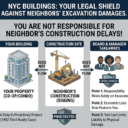
The 40 W. 20th St. Condominium has to sue to gain access to their neighbor’s property for an exterior project and the neighbor got $3,000 per month license fee, attorneys’ fees and other protections from the court. Best course is negotiating access agreements while negotiating the construction contract so there are no delays or unexpected issues. Sometimes, court intervention is the only way and you are stuck with what a court decides.

Read the decision. 

New York Governor Tolls Statute of Limitations Again

New York Governor Tolls Statute of Limitations Again

New York Governor Cuomo has been issuing a lot of Executive Orders this year because of the Coronavirus Pandemic. One of the more important ones for aggrieved parties and their attorneys involves statutes of limitations.  The time that a complainant has to commence a lawsuit before it is barred is called a statute of limitations. During the Coronavirus Pandemic, states like New York have temporarily stopped (or tolled) statutes of limitations from running.  This has been done in a series of Executive Orders by the Governor.  

It has been difficult, however, to follow the Governor’s tolling of statutes of limitations in those hodge podge of Executive Orders.  There has been little news about it and only a few random articles debating if the tolls will stand up in Court.  Creative lawyers will undoubtedly try to argue that the tolls are not constitutional or otherwise legally effective, but they have been essential to lawyers and aggrieved parties.  Because courts have been closed and clients and lawyers haven’t been able to meet and confer easily, tolls to maintain the status quo were the right solution.  There will be an end to the tolls, but when that will happen is not clear.

The first Order was Executive Order 202.8 on March 20, 2020, tolling to April 19, 2020.  Thus, if there was 5 days left on a statute of limitations on March 20th, there would still be 5 days left to sue on April 19th.  The Governor clearly stated that:

In accordance with the directive of the Chief Judge of the State to limit court operations to essential matters during the pendency of the COVID-19 health crisis,  any specific time limit for the commencement, filing, or service of any legal action, notice, motion, or other process or proceeding, as prescribed by the procedural laws of the state, including but not limited to the criminal procedure law, the family court act, the civil practice law and rules, the court of claims act, the surrogate’s court procedure act, and the uniform court acts, or by any other statute, local law, ordinance, order, rule, or regulation, or part thereof, is hereby tolled from the date of this executive order until April 19, 2020

About a week and a half before the toll was to expire on April 19th, the Governor issued Executive Order 202.14 on April 7th, giving attorneys a cushion of time to react in case the toll wasn’t extended.   That time the toll was extended to 11:59 pm on April 29, 2020.  The language of the Order, however, was cryptic, and buried amongst paragraphs and paragraphs of other provisions.  Indeed, the Order read:

By virtue of Executive Orders 202.3, 202.4, 202.5, 202.6, 202.7, 202.8, 202.10, 202.11, and 202.13 which closed or otherwise restricted public or private businesses or places of public accommodation, and which required postponement or cancellation of all non-essential gatherings of individuals of any size for any reason (e.g. parties, celebrations, games, meetings or other social events), all such Executive Orders shall be continued, provided that the expiration dates of such Executive Orders shall be aligned, such that all in-person business restrictions and workplace restrictions will be effective until 11:59 p.m. on April 29, 2020, unless later extended by a future Executive Order.

As we approached April 29th, on April 16th, the Governor issued Executive Order 202.18, extending the toll again to 11:59 pm on May 15, 2020.  The trouble with this Executive Order is that the language again was buried, and the www.governor.ny.gov website, had the wrong link for 202.18 as 202.19, so you couldn’t find it (its still hasn’t been corrected).  Executive Order 202.18, provides that:

Executive Order 202.14, which extended the provisions of Executive Orders 202.3, 202.4, 202.5, 202.6, 202.7, 202.8, 202.10, 202.11, and 202.13 which each closed or otherwise restricted public or private businesses or places of public accommodation, and which required postponement or cancellation of all non-essential gatherings of individuals of any size for any reason (e.g. parties, celebrations, games, meetings or other social events), is hereby continued, provided that the expiration date of such provisions of such Executive Orders shall be aligned, such that all in-person business restrictions and workplace restrictions will be effective until 11:59 p.m. on May 15, 2020, unless later extended by a future Executive Order. All enforcement mechanisms by state or local governments shall continue to be in full force an effect until May 15, 2020 unless later extended by a future Executive Order

On May 8th, the Governor acted again on the toll, issuing Executive Order 202.29.  The new toll was to Sunday, June 7, 2020.  Again, buried in the Order, the Governor said:

I, Andrew M. Cuomo, Governor of the State of New York, by virtue of the authority vested in me by Section 29-a of Article 2-B of the Executive Law, do hereby continue the suspensions and modifications of law, and any directives, not superseded by a subsequent directive, made by Executive Order 202.15, 202.16, 202.17, 202.18, 202.19, 202.20, and 202.21, for thirty days until June 7, 2020

On Friday June 5th, decisions had to be made by attorneys for clients impacted by the toll.  No Executive Order granted another toll arrived and it was not clear whether the toll would be extended again.  The Supreme Court in New York opened for electronic filings of new lawsuits, so it was possible that the Governor was not going to extend again. However, court’s like the New York City Small Claims Court do not accept electronic filings yet, so it was not possible to file a new lawsuit there.  

On Sunday June 7, 2020, the day that the toll was set to expire under the last Executive Order 202.29 (albeit, it wasn’t clear what time on June 7th it would expire because the last Order did not specify a time), the Governor on Sunday June 7th, issued Executive Order 202.38, extending the toll to Monday July 6, 2020, providing in a cryptic way that could only be deciphered by people following the chain of Executive Orders for months:

I, Andrew M. Cuomo, Governor of the State of New York, by virtue of the authority vested in me by Section 29-a of Article 2-B of the Executive Law, do hereby continue the suspensions and modifications of law, and any directives, not superseded by a subsequent directive, made by Executive Order 202 and each successor Executive Order up to and including Executive Order 202.14, as continued as contained in Executive Order 202.27 and 202.28 until July 6, 2020.

Until all of the New York State courts allow commencement of new lawsuits, the toll has to be extended so that the status quo is maintained.  Otherwise, statutes of limitations could be missed and claims lost.  Lawyers and their clients need to be aware of this important issue and make sure they are protected.  As July 6th approaches, my hope is that tolls will no longer be necessary as we have arrived at our new normal.


Facade Project Problems – Protecting Management and the Coop, Condo or HOA

Facade Project Problems – Protecting Management and the Coop, Condo or HOA

Before the Coronavirus pandemic caused exterior construction to grind to a halt, facade projects were commonplace throughout New York City and most metropolitan areas.  Associations with professional management and an attorney and engineer guiding them, have to all be prepared for problems that may occur.  Since COVID-19, we have received numerous calls about coops, condos and HOAs experiencing problems with their contractors, and as a result of thorough and well-thought out provisions in their contracts, they were protected and able to get out of their contracts or hold the contractor’s feet to the fire to get the association what it needed.

The contract is the most important thing when a dispute arises.  The terms are critical.  Sometimes associations have their engineer prepare the initial AIA contact and then have an attorney review the contract.  This is not suggested for a number of reasons.  Engineers are usually listed in a contract with terms that may favor the engineer.  For instance, there is a provision regarding intellectual property which favor the engineer over the association.  That provision should be changed and engineers typically include it.  If the association is having an attorney involved in the contract process (which it most definitely should be doing), then the attorney should be drafting the contract from the inception.  Another reason is that contract drafting is considered the practice of law and engineers are not licensed to draft contracts.  

Associations should make sure that their contracts are well thought out and comprehensive.   For instance, if an association did not include a provision permitting it to delay or terminate a contract for convenience or with, the Coronavirus shut down could have been devastating economically.

The Board of Managers of 215 East 80 Condominium had problems with its facade contractor Jerrick Associates back in 2016, and they are still litigating about it now.  The condo didn’t make the last $88,685 payment on the $700k plus contract because it claimed the job was poorly done and there were leaks into apartments resulting in damage.  The contractor filed a mechanic’s lien and then sued the condo and its management company Rudd Management in 2018. The Court just issued a decision and the litigation goes on.  The Court couldn’t decide the contractor’s claims for breach of contract and an account stated on evidence and couldn’t decide the condo’s counterclaims either.  The Court did dismiss the claims against management based on the agent for a disclosed principle doctrine, but it took 2 years to get to that point.

Hopefully the condominium included an attorney fee provision in the contract so that the breaching party is responsible for the non-breaching party’s legal fees and costs. This could be problematic for an association though if the contractor is correct and thus, the association could be responsible for the contractor’s legal fees and costs.

The condo and management should document the issues as they are happening during the project and coordinate with the engineer with respect to those issues so that there is good evidence if there is a dispute.  It is very difficult to do so years later.  In the 215 East 80 Condominium case, the engineer seemingly certified that the work for final payment was performed.  The Court, however, explained that the contract provided that certification of payment does not mean that the work was performed according to the contract and thus, did not entitle the contractor to summery judgment. The certification could be very persuasive at trial.  It certainly would have been better if the engineer and association were on the same page so that the engineer did not make such certification unless the certification was correct.  

As you can see, problems with facade contracts can be awful and lead to expensive lawsuits.  Knowing this, associations and management should be careful from the very beginning and make sure their contracts are thorough and comprehensive, that the execution of the project is well managed in a coordinated way by management, the attorney and engineer on behalf of the association.  The failure to document issues and coordinate efforts can lead to a lot of headaches when problems arise.

Read the decision here.

Walmart sued for Wrongful Covid-19 Death – Are Coop, Condo & HOA Boards Next?

Walmart sued for Wrongful Covid-19 Death – Are Coop, Condo & HOA Boards Next?

The inevitable has started.  People are suing because of COVID-19 infections.  A Walmart employee died from COVID-19 and his family is blaming Walmart for not protecting him during his employment.  We warned coops, condos and HOAs that lawsuits will likely happen and that they should be mindful of that in making decisions.  

One concern was whether boards should notify residents when employees or residents contract COVID-19.  We understand that some boards are and others aren’t. Some are afraid of violating privacy rights and some are more concerned about protecting their residents.  This unfortunately is a no win situation for boards.  If you take action and notify residents, you may be charged with violating privacy rights.  If you don’t take action and someone is later infected, they may complain that you didn’t take sufficient action to protect them, knowing that a dangerous condition existed in the building. 

In one instance a condominium was already involved in a lawsuit with a unit owner.  Counsel for the unit owner advised the condominium’s attorney that his client contracted COVID-19.  The owner wanted management to know so that delivery rules for the owner could be relaxed.  The notification was more about what can the condo do for the ill resident rather than any worry about the residents in the 100 plus other units. The attorney specifically warned that they will take legal action if the condo advised residents of the name or apartment number of the ill resident. They were unclear as to whether they approved of a general notice to residents that someone in the building tested positive and was ill.  

So, what’s a board and management to do knowing all of that?  They definitely have to comply with the privacy laws and naming the unit owner or apartment number would likely be a problem.  In that particular instance, the unit owner expressly stated through counsel that the unit owner did not consent to being specifically identified.  Other owners in that position may not object to identification in order to protect their neighbors.  If there is an objection to specific identification, a general statement that a resident in the building has contracted COVID-19 and people should be more careful to adhere to CDC guidelines when using the common areas should be ok.  The trouble is that communications demanding specific information will likely happen.  Some managers report that they include in their general communications that specific information cannot be provided and please do not communicate with us asking for this information.  

If the condo board did not generally notify residents and someone contracts the disease in the building, one would expect the same type of lawsuit that Walmart is now facing.  The resident who catches the disease may argue the the condo, like Walmart, didn’t do enough to protect the best interest of their community.  

Coop, condo and HOA Boards and management will continue to face these difficult situations.  How about employees who tested positive for COVID-19 and have recuperated and want to return to work.  These are tough situations for boards and managment, especially because the medical advice has been so equivocal at times including when someone can return to work in an essential job.  The positions on these types of issues seems to change daily.

Now that we are starting to see lawsuits in COVID-19 situations, boards and management have to be more vigilant in doing what is most reasonable for their entire community within the confines of privacy and other laws.  This will have to continue on a case-by-case basis for now.  Getting professional advice as to what is legal and making the most reasonable decision for the entire community based on that advice, is probably the best course of action until we learn more from the Courts in the lawsuits.

Checking your insurance coverage now is also a prudent thing to do.  There may be coverage under your general liability or directors and officers insurance policies.  Your insurance professional should be able to guide you. If you learn that claims arising out of COVID-19 are likely not covered then you may want to consider improving your insurance.

Read a news report on the Walmart lawsuit here .

  • 1
  • 2
  • …
  • 9
  • 10
  • 11
  • …
  • 13
  • 14

Recent Attorney Publications

  • When Contractors Lack Licenses: Key Lessons for Condos, Co-ops, and HOAs July 25, 2026
  • When Bankruptcy Won’t Stop Your Foreclosure Sale: What Condo Boards and Management Need to Know About Repeat Filers July 22, 2026
  • When Repetitive Filings Cross the Line: Lessons from Fulton v. Yameogo July 21, 2026
  • Condominium Boards: Why Being Aware of First Mortgage “Standing” Can Protect Your Community’s Bottom Line July 13, 2026
  • Winning the Common Charge Battle: How Condo Boards Prevail Against Defiant Unit Owners July 2, 2026

Contact Us

Send us a note and we'll get back to you promptly.

OFFICES

  • Manhattan Office
  • 315 Madison Avenue, Suite 4032, New York, New York 10017
  • 646.880.3000
  • 646.880.3048
  • Westchester Office
  • 44 South Broadway, 21st Floor, White Plains, New York 10601
  • 646.880.3000
  • 646.880.3048
  • Connecticut Office
  • 55 Post Road W, 2nd Floor, Westport, Connecticut 06880
  • 203.349.8100
  • 646.880.3048

Latest Publications

  • When Contractors Lack Licenses: Key Lessons for Condos, Co-ops, and HOAs July 25, 2026
  • When Bankruptcy Won’t Stop Your Foreclosure Sale: What Condo Boards and Management Need to Know About Repeat Filers July 22, 2026
  • When Repetitive Filings Cross the Line: Lessons from Fulton v. Yameogo July 21, 2026
  • Condominium Boards: Why Being Aware of First Mortgage “Standing” Can Protect Your Community’s Bottom Line July 13, 2026

© 2026 Colbert Law LLC Attorney Advertising. Prior results do not guarantee a similar outcome.

Highend Logo

Manhattan Office

  • 315 Madison Avenue, Suite 4032, New York, New York 10017
  • 646.880.3000
  • 646.880.3048

Westchester Office

  • 44 South Broadway, 21st Floor, White Plains, New York 10601
  • 646.880.3000
  • 646.880.3048

Connecticut Office

  • 55 Post Road W, 2nd Floor, Westport, Connecticut 06880
  • 203.349.8100
  • 646.880.3048

OUR EXPERTISE

When Contractors Lack Licenses: Key Lessons for Condos, Co-ops, and HOAs

July 25, 2026

A recent NYC Civil Court decision (Fortes v. Decorating and...

When Bankruptcy Won’t Stop Your Foreclosure Sale: What Condo Boards and Management Need to Know About Repeat Filers

July 22, 2026

For condominium boards foreclosing on unpaid common charges,...

When Repetitive Filings Cross the Line: Lessons from Fulton v. Yameogo

July 21, 2026

Community association boards—whether governing condos,...

Condominium Boards: Why Being Aware of First Mortgage “Standing” Can Protect Your Community’s Bottom Line

July 13, 2026

When a condominium unit owner defaults on their monthly...

Winning the Common Charge Battle: How Condo Boards Prevail Against Defiant Unit Owners

July 2, 2026

Condominium boards and property managers face a unique,...

When the Neighbor Builds: What Condo and Co-Op Boards Need to Know

June 29, 2026

Construction in New York City is a fact of life, but when a...

Succession Rights in Limited-Equity Co-ops: Practical Lessons from Mutual Redevelopment Houses v. Manyevitch

June 12, 2026

Succession disputes are among the most sensitive and...

The Post-Settlement Trap: What Fiondella Teaches Co-op Boards About Stipulations and Continuing Habitability Claims

June 9, 2026

For New York cooperative boards and managing agents,...

The Derivative Action Threat: Why “Limited Common Elements” Present Litigation Risks for Condominium Boards and Managers

May 16, 2026

A recent decision by the Appellate Division, First...

Governance and Rule-Making in the Modern Condominium

April 27, 2026

Reflections on 10MSW17D LLC v. Bd. of Managers of 10...

Don’t Delay: Why Timely Enforcement of Common Charges is Critical for Condo Boards

April 15, 2026

A recent decision from the Supreme Court of New York,...

RPAPL § 881 Licenses, and Why Fee Reimbursement Is a Core Deal Term

April 13, 2026

Boards and managers of condominiums, cooperatives, and...

The 432 Park Decision: A Masterclass in Risk Management for New York Condo Boards

April 2, 2026

New York condominium boards and management companies operate...

Protecting Your Building’s Integrity: Lessons from Board of Mgrs. of the 80th at Madison Condominium v. 1055 Madison Ave. Owners LLC

March 31, 2026

As a condominium board member or property manager, your...

Press Enter to search · Esc to close